


Anybody had any luck with home camber measurement?


 Anybody had any luck with home camber measurement?
I have front camber bolts on my Eclipse and shortly expect to install a pair on the xB2; however, paying for a "four wheel thrust" alignment to verify whether the value is optimal gets expensive, especially if it takes more than one try to bring it in.
I just tried making a camber "gauge" that can be held against the wheel rim (just slightly taller than the rim bead wall) and uses a pendulum to indicate the camber on a scale at the bottom. I've tested it against walls and a leveled floor and it seems accurate to better than .1 degree. However, even allowing for the sideways slope of my also upward sloped garage floor, I'm not able to replicate the camber numbers from my last Eclipse alignment (not even the one I haven't since fooled with ).
).

Is there a good solution to this? It's expensive paying for serial alignments and it seems like a very simple problem. I'd much prefer to be able to take the car in for a toe adjustment already knowing the camber is well within range.
I just tried making a camber "gauge" that can be held against the wheel rim (just slightly taller than the rim bead wall) and uses a pendulum to indicate the camber on a scale at the bottom. I've tested it against walls and a leveled floor and it seems accurate to better than .1 degree. However, even allowing for the sideways slope of my also upward sloped garage floor, I'm not able to replicate the camber numbers from my last Eclipse alignment (not even the one I haven't since fooled with
).Is there a good solution to this? It's expensive paying for serial alignments and it seems like a very simple problem. I'd much prefer to be able to take the car in for a toe adjustment already knowing the camber is well within range.

Member


SL Member
Joined: Oct 2009
Posts: 97
From: Clinton, TN
when i put my lowering springs on my tC i set the camber and toe at home. We race a late model stock car so we have a camber gauge, however it doesnt fit the wheel or hub on the tc....so what i did was just place a flat metal bar against the wheel and then place the camber gauge up against that. As far as your pendulum goes, the idea would work as long as you have your marks in the right spot. if you happen to have a magnetic angle finder (home depot) you could you it basically like i did the camber gauge and use a flat metal bar placed on your wheel. Now to your question about how to combat an uneven floor. At our race shop we are sure to put the racecar back in the same spot (marked by tape) every weekend so that when we take measurements they are taken from the same location on the floor. so....applying that to when i did my camber/toe, i pulled the car in, marked the floor, and then took measurements so that i could put the car back to those specs after i changed the springs. then i changed the springs and checked my toe and camber, which were not very far off at all.
Member
SL Member
Joined: Oct 2009
Posts: 97
From: Clinton, TN
you need to be sure that your car is within spec when you take the original measurements though.... so if your car is out of line atm then this idea wont really be of any help unless you have a perfectly flat floor (which is hard to come by).
The markings should definitely be correct. I used 1/16" increments on the scale and calculated the angles with the formula:
angle = arctangent (offset/height)
Comes out to aprox .204 degree per 1/16" increment with a 17.5" height. Using a ballpoint pen and ruler, it should be better than 1/32" (.10 degree) accuracy.
I was wondering if getting an alignment first and then taking measurements might be the answer. Then it wouldn't matter what my exact measurements are, it would just be a question of the deltas. Add ~.2 degree negative camber or whatever. I guess that would still translate into two shop alignments with resetting the toe afterwards; however, if the front camber was adjusted equally and opposite between the wheels, then the toe wouldn't change -- it would just be necessary to adjust the tie rod ends equally and opposite to restore steering wheel center.
Just wish they'd be willing to do just a front wheel alignment and not the doubly expensive four wheel thrust. Seems so crazy when the only available adjustment is front toe .
.
angle = arctangent (offset/height)
Comes out to aprox .204 degree per 1/16" increment with a 17.5" height. Using a ballpoint pen and ruler, it should be better than 1/32" (.10 degree) accuracy.
I was wondering if getting an alignment first and then taking measurements might be the answer. Then it wouldn't matter what my exact measurements are, it would just be a question of the deltas. Add ~.2 degree negative camber or whatever. I guess that would still translate into two shop alignments with resetting the toe afterwards; however, if the front camber was adjusted equally and opposite between the wheels, then the toe wouldn't change -- it would just be necessary to adjust the tie rod ends equally and opposite to restore steering wheel center.
Just wish they'd be willing to do just a front wheel alignment and not the doubly expensive four wheel thrust. Seems so crazy when the only available adjustment is front toe
.

Senior Member
SL Member
Joined: Feb 2010
Posts: 121
From: Royal Oak
as pnoo2 said it should work in theory as long as you do what you can to eliminate any environmental variables that would skew measurement.
The funny thing is, I was looking at the camber gauge I use for 1/10 r/c and thought "why can't this apply on a larger scale?" and here you are with a device that works on the same principle lol.
My suggestion is to T-a panel that spans the wheel on the x-axis so that you can hold the gauge square to the wheel and add a pivot pipe at the corner where the wheel meets the ground so the gauge is fixed 90 degrees upright. The resulting angle should result in more reliable accuracy.

The funny thing is, I was looking at the camber gauge I use for 1/10 r/c and thought "why can't this apply on a larger scale?" and here you are with a device that works on the same principle lol.
My suggestion is to T-a panel that spans the wheel on the x-axis so that you can hold the gauge square to the wheel and add a pivot pipe at the corner where the wheel meets the ground so the gauge is fixed 90 degrees upright. The resulting angle should result in more reliable accuracy.
Member
SL Member
Joined: Oct 2009
Posts: 97
From: Clinton, TN
I use to race 1/8 scale buggies....had that same camber gauge. the toe could still be a little bit off even if you adjust the two cambers the same... If the car was lowered the angles of everything change....so if you adjust out the camber to make the camber correct, the toe doesnt necessarily change proportionately to the amount of change in camber. You can easily check toe by:
1. centering the steering wheel
2. have some sort of "toe plates" that go horizontally across the wheel....there must be 2, one for each wheel. then use a measuring tape to measure in front of the tire, and behind the tire....if the two measurements are the same then the toe is perfectly straight. if the rear measurement is longer then the car is toed in.....if the front is longer it is toed out....ill post a pic of what we use on our late model to set the toe.
[IMG]file:///C:/Users/Paul/AppData/Local/Temp/moz-screenshot.png[/IMG][IMG]file:///C:/Users/Paul/AppData/Local/Temp/moz-screenshot-1.png[/IMG]
1. centering the steering wheel
2. have some sort of "toe plates" that go horizontally across the wheel....there must be 2, one for each wheel. then use a measuring tape to measure in front of the tire, and behind the tire....if the two measurements are the same then the toe is perfectly straight. if the rear measurement is longer then the car is toed in.....if the front is longer it is toed out....ill post a pic of what we use on our late model to set the toe.
[IMG]file:///C:/Users/Paul/AppData/Local/Temp/moz-screenshot.png[/IMG][IMG]file:///C:/Users/Paul/AppData/Local/Temp/moz-screenshot-1.png[/IMG]

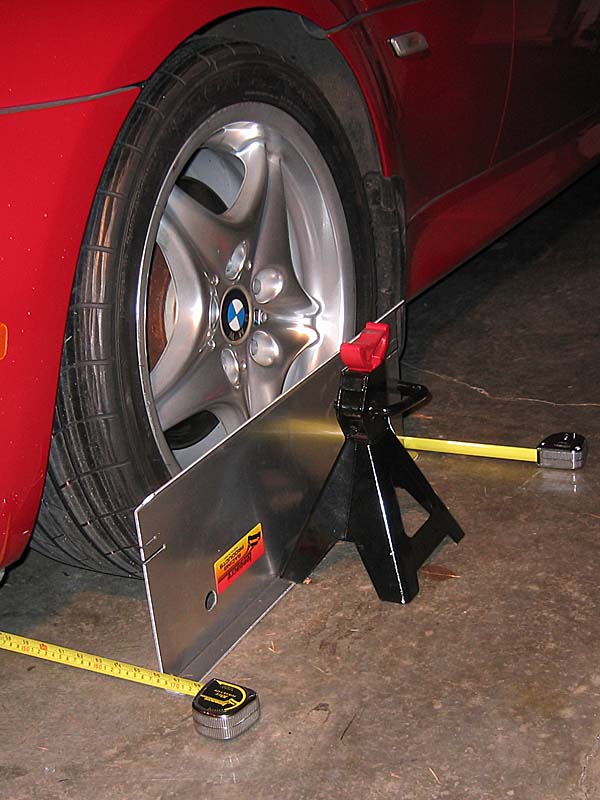
Thanks very much for the inputs ! Sorry about the delay in getting back, but I really wanted to get a bit further down the pike first. Today I found my xB2 with Eibach Prokit alignment results, and that at last provided an opportunity to calibrate the gauge and garage floor against some real numbers. I moved the xB2 into the garage, marked the driver's side wheel centers on the floor, and took measurements with the gauge. I then compared the measurements with the actuals to get correction factors.
Then I brought in the Eclipse aligned to the same floor marks, measured, added the corrections, and reviewed the resulting camber numbers. The front left and right appear right on the money from when I did my equal and opposite adjustment awhile back (camber bolts in both fronts). However, the rears were both out, especially the one I tried to bring in using the eyeball method (over one degree more negative camber than the other wheel ). Using my corrected measurements, I readjusted the rear cambers to try to bring them both reasonably within range and equal.
So, I don't really know how good my rear cambers are now, but the resulting toe is definitely out, so it needs an alignment and that'll provide a further opportunity to see how well the gauge is doing. Both the before and after alignment values should be interesting. I'll report the results.
PS. The Eclipse and xB2 both have McPherson strut suspension up front, but the xB2 has torsion beam rear suspension whereas the Eclipse has double-wishbone. I'm thinking that may result in different rear gauge corrections -- got to see what the alignment comes up with.
! Sorry about the delay in getting back, but I really wanted to get a bit further down the pike first. Today I found my xB2 with Eibach Prokit alignment results, and that at last provided an opportunity to calibrate the gauge and garage floor against some real numbers. I moved the xB2 into the garage, marked the driver's side wheel centers on the floor, and took measurements with the gauge. I then compared the measurements with the actuals to get correction factors.Then I brought in the Eclipse aligned to the same floor marks, measured, added the corrections, and reviewed the resulting camber numbers. The front left and right appear right on the money from when I did my equal and opposite adjustment awhile back (camber bolts in both fronts). However, the rears were both out, especially the one I tried to bring in using the eyeball method (over one degree more negative camber than the other wheel
). Using my corrected measurements, I readjusted the rear cambers to try to bring them both reasonably within range and equal.So, I don't really know how good my rear cambers are now, but the resulting toe is definitely out, so it needs an alignment and that'll provide a further opportunity to see how well the gauge is doing. Both the before and after alignment values should be interesting. I'll report the results.
PS. The Eclipse and xB2 both have McPherson strut suspension up front, but the xB2 has torsion beam rear suspension whereas the Eclipse has double-wishbone. I'm thinking that may result in different rear gauge corrections -- got to see what the alignment comes up with.
Last edited by TrevorS; May 3, 2010 at 03:21 AM.
Then I brought in the Eclipse aligned to the same floor marks, measured, added the corrections, and reviewed the resulting camber numbers. The front left and right appear right on the money from when I did my equal and opposite adjustment awhile back (camber bolts in both fronts). However, the rears were both out, especially the one I tried to bring in using the eyeball method (over one degree more negative camber than the other wheel ). Using my corrected measurements, I readjusted the rear cambers to try to bring them both reasonably within range and equal.
So, I don't really know how good my rear cambers are now, but the resulting toe is definitely out, so it needs an alignment and that'll provide a further opportunity to see how well the gauge is doing. Both the before and after alignment values should be interesting. I'll report the results.
PS. The Eclipse and xB2 both have McPherson strut suspension up front, but the xB2 has torsion beam rear suspension whereas the Eclipse has double-wishbone. I'm thinking that may result in different rear gauge corrections -- got to see what the alignment comes up with.
). Using my corrected measurements, I readjusted the rear cambers to try to bring them both reasonably within range and equal.So, I don't really know how good my rear cambers are now, but the resulting toe is definitely out, so it needs an alignment and that'll provide a further opportunity to see how well the gauge is doing. Both the before and after alignment values should be interesting. I'll report the results.
PS. The Eclipse and xB2 both have McPherson strut suspension up front, but the xB2 has torsion beam rear suspension whereas the Eclipse has double-wishbone. I'm thinking that may result in different rear gauge corrections -- got to see what the alignment comes up with.
For me, the important thing is my camber guage does work, I just have to know how to correct the values with a known vehicle position for measurement. Perhaps more usefully, the gauge makes it easy to verify relative adjustments, like before/after with camber bolts.
Thinking of my earlier equal and opposite front camber bolt and tie-rod end adjustments, the camber numbers came out very close (a near match), but with a small toe error. LF was -.09 degree toe and RF was -.03 degree for a total toe of -.12 out of a spec range of -.24 to +.24. Clearly acceptable, but easily improved upon by getting an alignment!
As far as I'm concerned, the "camber gauge" is a keeper
! (Along with a copy of the correction factors.)

Thread
Thread Starter
Forum
Replies
Last Post
Sgtfluffy16
Regional - Northeast
3
Jul 28, 2021 10:32 PM
Darrenohooligan
PPC: Suspension / Brakes
0
Sep 26, 2015 07:21 AM
BlingSlade
Scion xB 1st-Gen Owners Lounge
0
Sep 5, 2015 08:52 AM
