


Let's all stop living obliviously


Thread Starter
Senior Member


SL Member
Joined: Dec 2005
Posts: 208
From: Huntington Beach, CA
 Let's all stop living obliviously
You might feel fine, but high oil cost, scarcity, means our American way of life is about to come crashing down
Guy R. McPherson
University of Arizona professor
Apr. 6, 2008 12:00 AM
Peak oil spells the end of civilization. And, if it's not already too late, perhaps it will prevent the extinction of our species.
M. King Hubbert, a petroleum geologist employed by Shell Oil Co., described peak oil in 1956. Production of crude oil, like the production of many non-renewable resources, follows a bell-shaped curve. The top of the curve is termed "peak oil," or "Hubbert's peak," and it represents the halfway point for production.
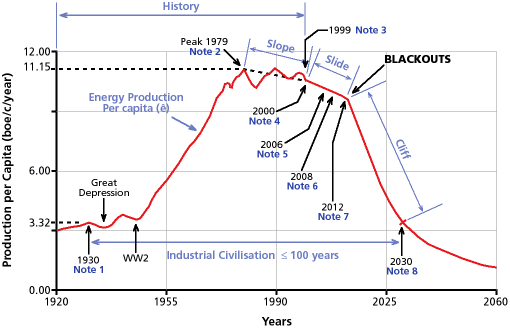
The bell-shaped curve applies at all levels, from field to country to planet. After discovery, production ramps up relatively quickly. But when the light, sweet crude on top of the field runs out, increased energy and expense are required to extract the underlying heavy, sour crude. At some point, the energy required to extract a barrel of oil exceeds the energy contained in barrel of oil, so the pumps shut down.
advertisement
Most of the world's oil pumps are about to shut down.
We have sufficient supply to keep the world running for 30 years or so, at the current level of demand. But that's irrelevant because the days of inexpensive oil are behind us. And our modern society absolutely demands cheap oil. Never mind the 3,000-mile Caesar salad to which we've become accustomed. Cheap oil forms the basis for the 12,000-mile supply chain underlying the "just-in-time" delivery of plastic toys from China.
There goes next year's iPod.
In 1956, Hubbert predicted the continental United States would peak in 1970. He was correct, and the 1970s gave us a small, temporary taste of the sociopolitical and economic consequences of expensive oil.
We passed the world oil peak in 2005, and we've been easing down the other side by acquiring oil at the point of a gun - actually, guns are the smallest of the many weapons we're using - paying more for oil and destroying one culture after another as the high price of crude oil forces supply disruptions and power outages in Third World countries.
The world peaked at 74.3 million barrels per day in May 2005. The two-year decline to 73.2 million barrels per day produced a doubling of the price of crude. Later this year, we fall off the oil-supply cliff, with global supply plummeting below 70 million barrels/day. Oil at merely $100 per barrel will seem like the good old days.
Within a decade, we'll be staring down the barrel of a crisis: Oil at $400 per barrel brings down the American Empire, the project of globalization and water coming through the taps. Never mind happy motoring through the never-ending suburbs in the Valley of the Sun. In a decade, unemployment will be approaching 100 percent, inflation will be running at 1,000 percent and central heating will be a pipe dream.
In short, this country will be well on its way to the post-industrial Stone Age.
After all, no alternative energy sources scale up to the level of a few million people, much less the 6.5 billion who currently occupy Earth. Oil is necessary to extract and deliver coal and natural gas. Oil is needed to produce solar panels and wind turbines, and to maintain the electrical grid.
Ninety percent of the oil consumed in this country is burned by airplanes, ships, trains and automobiles. You can kiss goodbye groceries at the local big-box grocery store: Our entire system of food production and delivery depends on cheap oil.
If you're alive in a decade, it will be because you've figured out how to forage locally.
The death and suffering will be unimaginable. We have come to depend on cheap oil for the delivery of food, water, shelter and medicine. Most of us are incapable of supplying these four key elements of personal survival, so trouble lies ahead when we are forced to develop means of acquiring them that don't involve a quick trip to Wal-Mart.
On the other hand, the forthcoming cessation of economic growth is truly good news for the world's species and cultures. In addition, the abrupt halt of fossil-fuel consumption may slow the warming of our planetary home, thereby preventing our extinction at our own hand.
Our individual survival, and our common future, depends on our ability to quickly make other arrangements. We can view this as a personal challenge, or we can take the Hemingway out. The choice is ours.
For individuals interested in making other arrangements, it's time to start acquiring myriad requisite skills. It is far too late to save civilization for 300 million Americans, much less the rest of the planet's citizens, but we can take joy in a purpose-filled, intimate life.
It's time to push away from the shore, to let the winds of change catch the sails of our leaky boat.
It's time to trust in ourselves, our neighbors and the Earth that sustains us all.
Painful though it might be, it's time to abandon the cruise ship of empire in exchange for a lifeboat.
Guy R. McPherson is a professor of conservation biology at the University of Arizona.
www.lifeaftertheoilcrash.net
You think things are bad with the economy, gas prices, etc. We haven't seen NOTHING YET....
Guy R. McPherson
University of Arizona professor
Apr. 6, 2008 12:00 AM
Peak oil spells the end of civilization. And, if it's not already too late, perhaps it will prevent the extinction of our species.
M. King Hubbert, a petroleum geologist employed by Shell Oil Co., described peak oil in 1956. Production of crude oil, like the production of many non-renewable resources, follows a bell-shaped curve. The top of the curve is termed "peak oil," or "Hubbert's peak," and it represents the halfway point for production.
The bell-shaped curve applies at all levels, from field to country to planet. After discovery, production ramps up relatively quickly. But when the light, sweet crude on top of the field runs out, increased energy and expense are required to extract the underlying heavy, sour crude. At some point, the energy required to extract a barrel of oil exceeds the energy contained in barrel of oil, so the pumps shut down.
advertisement
Most of the world's oil pumps are about to shut down.
We have sufficient supply to keep the world running for 30 years or so, at the current level of demand. But that's irrelevant because the days of inexpensive oil are behind us. And our modern society absolutely demands cheap oil. Never mind the 3,000-mile Caesar salad to which we've become accustomed. Cheap oil forms the basis for the 12,000-mile supply chain underlying the "just-in-time" delivery of plastic toys from China.
There goes next year's iPod.
In 1956, Hubbert predicted the continental United States would peak in 1970. He was correct, and the 1970s gave us a small, temporary taste of the sociopolitical and economic consequences of expensive oil.
We passed the world oil peak in 2005, and we've been easing down the other side by acquiring oil at the point of a gun - actually, guns are the smallest of the many weapons we're using - paying more for oil and destroying one culture after another as the high price of crude oil forces supply disruptions and power outages in Third World countries.
The world peaked at 74.3 million barrels per day in May 2005. The two-year decline to 73.2 million barrels per day produced a doubling of the price of crude. Later this year, we fall off the oil-supply cliff, with global supply plummeting below 70 million barrels/day. Oil at merely $100 per barrel will seem like the good old days.
Within a decade, we'll be staring down the barrel of a crisis: Oil at $400 per barrel brings down the American Empire, the project of globalization and water coming through the taps. Never mind happy motoring through the never-ending suburbs in the Valley of the Sun. In a decade, unemployment will be approaching 100 percent, inflation will be running at 1,000 percent and central heating will be a pipe dream.
In short, this country will be well on its way to the post-industrial Stone Age.
After all, no alternative energy sources scale up to the level of a few million people, much less the 6.5 billion who currently occupy Earth. Oil is necessary to extract and deliver coal and natural gas. Oil is needed to produce solar panels and wind turbines, and to maintain the electrical grid.
Ninety percent of the oil consumed in this country is burned by airplanes, ships, trains and automobiles. You can kiss goodbye groceries at the local big-box grocery store: Our entire system of food production and delivery depends on cheap oil.
If you're alive in a decade, it will be because you've figured out how to forage locally.
The death and suffering will be unimaginable. We have come to depend on cheap oil for the delivery of food, water, shelter and medicine. Most of us are incapable of supplying these four key elements of personal survival, so trouble lies ahead when we are forced to develop means of acquiring them that don't involve a quick trip to Wal-Mart.
On the other hand, the forthcoming cessation of economic growth is truly good news for the world's species and cultures. In addition, the abrupt halt of fossil-fuel consumption may slow the warming of our planetary home, thereby preventing our extinction at our own hand.
Our individual survival, and our common future, depends on our ability to quickly make other arrangements. We can view this as a personal challenge, or we can take the Hemingway out. The choice is ours.
For individuals interested in making other arrangements, it's time to start acquiring myriad requisite skills. It is far too late to save civilization for 300 million Americans, much less the rest of the planet's citizens, but we can take joy in a purpose-filled, intimate life.
It's time to push away from the shore, to let the winds of change catch the sails of our leaky boat.
It's time to trust in ourselves, our neighbors and the Earth that sustains us all.
Painful though it might be, it's time to abandon the cruise ship of empire in exchange for a lifeboat.
Guy R. McPherson is a professor of conservation biology at the University of Arizona.
www.lifeaftertheoilcrash.net
You think things are bad with the economy, gas prices, etc. We haven't seen NOTHING YET....


Senior Member
Fail, INC
SL Member
Joined: Mar 2007
Posts: 2,435
From: Taxachusetts
I'm sure some people will not take that seriously, and some will panic and talk about it with everyone they know and double-check the facts.
I on the other hand, i'm not really nervous about it but I recognize the facts. I don't think it will happen in 10 years, but i'm sure i'll live to see the downward spiral. Which, in fact, i'm pretty happy with. Lots of people lived full simplistic easy lives before this generation, now maybe we'll go back to the way it was and appreciate the little things.
Plus, I just watched I Am Legend, and hopefully I will survive longer than the others and perhaps I will be the one borrowing GT500's and chasing down deer with a sniper rifle.
I on the other hand, i'm not really nervous about it but I recognize the facts. I don't think it will happen in 10 years, but i'm sure i'll live to see the downward spiral. Which, in fact, i'm pretty happy with. Lots of people lived full simplistic easy lives before this generation, now maybe we'll go back to the way it was and appreciate the little things.
Plus, I just watched I Am Legend, and hopefully I will survive longer than the others and perhaps I will be the one borrowing GT500's and chasing down deer with a sniper rifle.

Senior Member
SL Member
Joined: Sep 2005
Posts: 1,167
From: Shreveport, LA
Sorry, I don't buy it.
I've been hearing this doom and gloom for far too long.
Prices are high not because the world is running out of oil, it's because our countries are held hostage by environmentalists who have filed lawsuit after lawsuit to stop any and every new refinery that corporations have attempted to build in the last 30 years. Our demand has nearly tripled. Our supply capacity, has not.
In addition, we cannot explore or drill for oil anywhere near here. More injunctions, more greedy states looking for a cut of profits, and more and more regulation. It's actually cheaper to import it, than to fight the local nutcases to drill locally. If that's not bad enough, the government charges over 40 cents of tax per gallon.
If we drilled in ANWAR... off the coast of Kalifornia.... in the gulf coast.... and in several other areas with CONFIRMED multi-billion barrel potential... then we would have plenty of DOMESTICALLY PRODUCED oil that would last until infrastructure is built to support something else.
This is how people, particularly professors with nothing else to do, get attention for their governmental research support.
I've been hearing this doom and gloom for far too long.
Prices are high not because the world is running out of oil, it's because our countries are held hostage by environmentalists who have filed lawsuit after lawsuit to stop any and every new refinery that corporations have attempted to build in the last 30 years. Our demand has nearly tripled. Our supply capacity, has not.
In addition, we cannot explore or drill for oil anywhere near here. More injunctions, more greedy states looking for a cut of profits, and more and more regulation. It's actually cheaper to import it, than to fight the local nutcases to drill locally. If that's not bad enough, the government charges over 40 cents of tax per gallon.
If we drilled in ANWAR... off the coast of Kalifornia.... in the gulf coast.... and in several other areas with CONFIRMED multi-billion barrel potential... then we would have plenty of DOMESTICALLY PRODUCED oil that would last until infrastructure is built to support something else.
This is how people, particularly professors with nothing else to do, get attention for their governmental research support.


Senior Member

SL Member
Joined: Mar 2005
Posts: 290
From: Santa Clarita, CA
what about other energy sources like solar, wind, and water... is all the money thats being invested in research for these just going to waste?!
when people have no choice... they will change and get used to it...or die
when people have no choice... they will change and get used to it...or die


Senior Member
Club One
SL Member
Joined: Jun 2005
Posts: 1,812
Originally Posted by tc4joe
what about other energy sources like solar, wind, and water... is all the money thats being invested in research for these just going to waste?!

Senior Member
SL Member
Joined: Oct 2004
Posts: 2,794
From: Hanover, PA
I tend to look at this stuff from both sides of the argument. There are plenty of people out there who want us to panic. They want us to believe that the world is in much worse shape than it is. There are also people out there who want to put on blinders and refuse to believe that there is ANYTHING to worry about. I find myself in the middle. I can see that we have done some damage to the environment. It also doesn't take a genius to see that oil is a non-renewable resource. Once it's gone, it's gone. It may not happen in my lifetime, but it IS going to happen. We need to do what we can (both corporately and as individuals) to clean up our act, stop wasting resources, and start working toward renewable energy. We have made some progress, but we need to do much more.
Senior Member
SL Member
Joined: Oct 2004
Posts: 2,794
From: Hanover, PA
Originally Posted by jsa3mm
Anyone know of the inventor that got a carburetted car to get over 70mpg back in the 70s? No? Really...guess who bought his ideas and patents? Big oil
Senior Member
Club One
SL Member
Joined: Jun 2005
Posts: 1,812
So what! I am not a enviro-nut, but big oil holds back way more than the enviro-nuts who are trying to better our world. I personally know someone who made a generator that ran on hydrogen that he cultivated from salt water. Why doesn't he share his knowledge? He is afraid of being hurt physically and he doesn't want the oil companies ruining what he has done by locking it away forever.
Senior Member
SL Member
Joined: Oct 2004
Posts: 2,794
From: Hanover, PA
Originally Posted by jsa3mm
I personally know someone who made a generator that ran on hydrogen that he cultivated from salt water. Why doesn't he share his knowledge? He is afraid of being hurt physically and he doesn't want the oil companies ruining what he has done by locking it away forever.
BTW, who exactly is "Big Oil"? Is it Exxon-Mobil? Is it Chevron? Is it BP? You do realize that these people are in direct competition with each other...right? I highly doubt they sit around and agree to pool their money and efforts to do anything.
Senior Member
Club One
SL Member
Joined: Jun 2005
Posts: 1,812
I highly doubt that they don't share much information with each other. Big Oil, imho, are the companies that are huge corporations. I personally don't like big corporations in any market. When a company gets big enough to slight our government to do what they want instead of what is good for the people of America I have a problem. Lobbyists should not be allowed in government.
Senior Member
SL Member
Joined: Sep 2005
Posts: 1,167
From: Shreveport, LA
Originally Posted by Sciond
the scarier it is the more truthful it usually is
Doom and gloom gets attention. Especially in today's media. The scarier it is, the more people pay attention, freak out, and go ape____.
Come on, everybody's freaking out because the Mayans calendar "resets" in 2012. Y2K went over without a hitch. Bird flu never destroyed America. Global warming is a complete farce when you look at older data in perspective. It's always one CRISIS after another, and ya know what the truth usually is ? Just people making ____ up for attention.