


Risk with intalling subs?


Senior Member


Scikotics
SL Member
Joined: Dec 2006
Posts: 2,476
From: Patuxent River, MD

To have a safe install, just make sure you place a fuse in the engine bay in-line between the battery (+) and your amp. Use an appropriate gauge wire to prevent resistive heating of the wire 8 AWG for under 600W, 4 AWG above for runs under 10 feet. You can get away with running 4 AWG from the battery to a power distribution block, then 8 AWG from the block to each amp if you're using multiple amps. Use a solid ground connection with a short run between your amp (-) and a bolt to the car chassis, use the same gauge ground wire as you use for power, and run the amp turn-on to your stereo or a wire that only has power with the key in and on Accessory or On.
The cap will be more of a drain on your electrical system. They do have losses and therefore need to constantly charge to maintain voltage. it's not a large current draw but can add up to a dead battery if the car isn't started in a while (weeks).
Final tip, to extend the battery life, put it on a charger once a week or so. The modern gel batteries are made for charging without having to fully cycle them first and your alternator wasn't built to be a charger, only to run the car electrical system while driving. You can also consider doing a "Big 3" wiring upgrade, search for it here on SL.
I'm running a JL 500/1, 300/4, Mac mini and 7" touchscreen on a stock battery without incident.
The cap will be more of a drain on your electrical system. They do have losses and therefore need to constantly charge to maintain voltage. it's not a large current draw but can add up to a dead battery if the car isn't started in a while (weeks).
Final tip, to extend the battery life, put it on a charger once a week or so. The modern gel batteries are made for charging without having to fully cycle them first and your alternator wasn't built to be a charger, only to run the car electrical system while driving. You can also consider doing a "Big 3" wiring upgrade, search for it here on SL.
I'm running a JL 500/1, 300/4, Mac mini and 7" touchscreen on a stock battery without incident.

Senior Member

SL Member
Joined: Jan 2006
Posts: 2,338
From: San Diego (Mira Mesa), CA
Originally Posted by rocketgyrl
PLEASE, don't spout one-line answers without qualifying the statement.

It's not just neb, but so many here that don't quantify their statements. If a person hears something, even if they believe it to be true, but they don't understand it sufficiently to explain it, they'd likely be better off not sharing, because often as not it's misinformation.
I believe the following is another example;
Originally Posted by vettereddie
The cap will be more of a drain on your electrical system. They do have losses and therefore need to constantly charge to maintain voltage. it's not a large current draw but can add up to a dead battery if the car isn't started in a while (weeks).
If you can't explain it, that's ok, as you can always retract your statements.
Senior Member
Scikotics
SL Member
Joined: Dec 2006
Posts: 2,476
From: Patuxent River, MD
No problem, I always am annoyed by a lack of data. Capacitors are not perfect and, in real world applications, are "lossy". Capacitors as a physical device do exhibit an internal resistance based on the electrolytic caps utilizing semiconductive oxide layers for anodes. Here's the first article I ran across when doing a search; see
http://electrochem.cwru.edu/ed/encyc...electr-cap.htm for the full details;
here is an excerpt:
It's late and I don't have the time at the moment to post a full corralary on capacitor rating vs. leakage current, needless to say the larger the cap based on cross-sectional area of the plates the greater the leakage current will generally be, usually in the milliamp range for under 1 Farad. By itself and in good working condition, it would take quite a long time to discharge an automotive battery, but coupled with a partially discharged source if the electrical system draw was greater than the alternator output capacity and it can reach a tipping point.
If I have time tomorrow I'll try and find the general equation for calculating this. Search electrolytic capacitor leakage current for more information, and keep in mind that most examples will be using caps in the microfarad range, where leakage current is nominal. For car audio applications 1 Farad and larger, it can become significant but will vary by manufacturer and materials used.
http://electrochem.cwru.edu/ed/encyc...electr-cap.htm for the full details;
here is an excerpt:
Second, once the foil is in a capacitor, the capacitor "fill" electrolyte continues the healing work of the original forming electrolyte, repairing and thickening the dielectric locally as required. This healing process is driven by the capacitor's dc leakage current, which is drawn whenever a dc voltage is applied to the capacitor, that is, whenever it is in operation.
The disadvantage of electrolytic capacitors is the non-ideal, lossy characteristics which arise from the semiconductive oxide properties, double-layer effects from the electrolyte-oxide charge-space region, resistive losses from the high electrolyte resistivity, frequency response roll off due to the roughness of the surface oxide, and finite capacitor life due to breakdown and degradation of the electrolyte.
If I have time tomorrow I'll try and find the general equation for calculating this. Search electrolytic capacitor leakage current for more information, and keep in mind that most examples will be using caps in the microfarad range, where leakage current is nominal. For car audio applications 1 Farad and larger, it can become significant but will vary by manufacturer and materials used.
Senior Member
SL Member
Joined: Jan 2006
Posts: 2,338
From: San Diego (Mira Mesa), CA
^ Ok, but the same is essentially true for a car battery. In your previous post it seemed you were implying that having a cap connected would drain the battery faster than it would normally lose it's charge.
So do you really believe that's the case? If so, you really feel it's enough cause for concern to warrant you citing such as a consideration to not use a cap? This is what I was actually questioning, not capacitor technology.
So do you really believe that's the case? If so, you really feel it's enough cause for concern to warrant you citing such as a consideration to not use a cap? This is what I was actually questioning, not capacitor technology.
Senior Member
Scikotics
SL Member
Joined: Dec 2006
Posts: 2,476
From: Patuxent River, MD
To answer your question, yes, having a capacitor connected will drain a battery faster than not having one, and yes, it is enough to cite not using one for car audio application. As I said, finding data on large electrolytic capacitors is difficult at best, the datasheets seem to usually stop at .1 Farad. Attached is a Capacitor leakage chart for standard aluminum electrolytic capacitors, but it stops at .2 Farads.
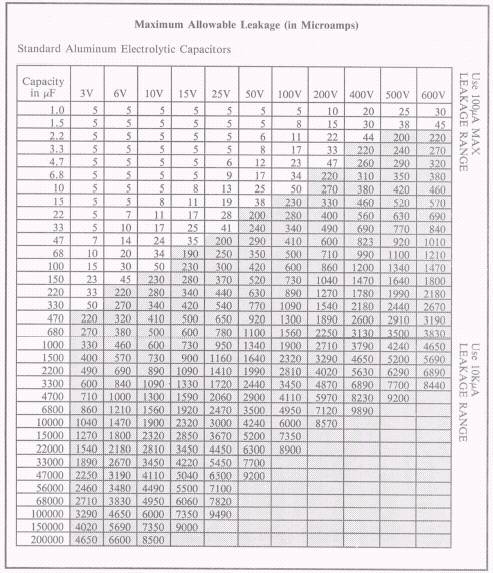
You can plot that if at 10V a .1F cap has a leakage of 6 mA and a .2F cap has a leakage of 8.5, a 1 Farad will have a leakage current of around 20 mA-50 mA. 20 mA is also the range of electrolytic capacitor leakage current testers. This may not seem like alot, but given your dome light draws ~100 mA - 400 mA, it's in the same ballpark, and I don't think there is debate that leaving your dome light on for long periods (several days to a week) will kill a battery.
These are just my opinions backed by loose engineering data I was able to scrounge up on short notice, but why spend money on something whose performance is debateable when there are more documented and proven methods for upgrading the electrical system (ground path upgrade, alternator upgrade, battery upgrade).
You can plot that if at 10V a .1F cap has a leakage of 6 mA and a .2F cap has a leakage of 8.5, a 1 Farad will have a leakage current of around 20 mA-50 mA. 20 mA is also the range of electrolytic capacitor leakage current testers. This may not seem like alot, but given your dome light draws ~100 mA - 400 mA, it's in the same ballpark, and I don't think there is debate that leaving your dome light on for long periods (several days to a week) will kill a battery.
These are just my opinions backed by loose engineering data I was able to scrounge up on short notice, but why spend money on something whose performance is debateable when there are more documented and proven methods for upgrading the electrical system (ground path upgrade, alternator upgrade, battery upgrade).
Senior Member
SL Member
Joined: Jan 2006
Posts: 2,338
From: San Diego (Mira Mesa), CA
Originally Posted by vettereddie
To answer your question, yes, having a capacitor connected will drain a battery faster than not having one, and yes, it is enough to cite not using one for car audio application.
Originally Posted by vettereddie
You can plot that if...
Originally Posted by vettereddie
These are just my opinions backed by loose engineering data I was able to scrounge up on short notice...
Originally Posted by vettereddie
...why spend money on something whose performance is debateable when there are more documented and proven methods for upgrading the electrical system (ground path upgrade, alternator upgrade, battery upgrade).
I've used a cap in all my systems for the last 17 years or so. Never in that time did the cap cause the battery to run down, even w/o starting some vehicles for as long as 3 weeks. Most amps tend to take power in large "gulps", as opposed to a steady draw from the battery. If you're playing music with a lot of dynamic range, some amps may not be able to get adequate current when they need it immediately and have to go through 4ga wire 20ft long from a source that's resistive (comparitively). However, with a cap wired near the amp it has an immediate energy reserve that'll provide all the power required to reproduce that big bottom end chord. There are also many 4ch. amps that have only a single power supply, and many consumers that use such amps to power their front speakers with 2ch, bridging the remaining two channels to power a sub. In such scenarios, sometimes the bass can "sag", because the amp can't pull power from the battery fast enough, and adding a cap can resolve the issue. So speaking from a lot personal experience, caps can help, they are worth the minimal cost, and there's really no reason why a person shouldn't use one. They're not always needed, but they certainly won't hurt, and they can help some systems.
Not arguing with you, just my $0.02, fwiw.

EDIT: To add a couple more points; A cap can also help with the single 4ch amp scenario mentioned above, by improving SQ on the mid-hi end, when the bass demands don't leave adequate energy reserves for the other channels, due to the lack of internal capacitance. If you're using large amps with a lot of power reserves and aren't pushing them, then a cap likely wouldn't improve things. However, if you're trying to extract the most from a low powered system, a cap can improve SQ. They're also implemented by a lot of SPL competitors (at least if/when using class AB amps), and I'm sure they feel there's enough difference to warrant the time & effort.
Manufacturers are limited on how much capacitance they build into their amps, because there's only so much room, and there are also cost/profit considerations. While they want to ensure the capacitance is adequate to meet the power supply demands at rated power, most of them would actually like to include more, as that would help ensure performance is maintained over a broader range of conditions and demands placed on the amp. By wiring a cap close to the amp, you're just adding what many amp designers would like to implement if they didn't have constraints.

Senior Member
Scikotics
SL Member
Joined: Dec 2006
Posts: 2,476
From: Patuxent River, MD
It's in the owner's manual under the chapter talking about the gauge lights.
1) With the car on, press the button to show odometer miles, not Trip A or Trip B
2) Turn the car off
3) Press and hold in the odometer button
4) Turn the keys to on
5) Watch the clock display, there will be a little line on the bottom that blinks and gets shorter. After about 5 seconds, the odometer flashes all zeros
6) let go of the odometer button
7) turn the car off
The maintenance light should be reset at this point.
1) With the car on, press the button to show odometer miles, not Trip A or Trip B
2) Turn the car off
3) Press and hold in the odometer button
4) Turn the keys to on
5) Watch the clock display, there will be a little line on the bottom that blinks and gets shorter. After about 5 seconds, the odometer flashes all zeros
6) let go of the odometer button
7) turn the car off
The maintenance light should be reset at this point.

Senior Member
SoCal tC Club
SL Member
Joined: Aug 2007
Posts: 1,077
i didn't read every post but cap's help for certain things.. like if you have a strong amp it takes alot of power and everytime the beat hit's your lights will dim and its sooo annoying..so i got a cap and that fixed that..

Member
SL Member
Joined: Oct 2007
Posts: 80
From: Missouri
You dont need a cap. Go to www.caraudio.com and read some of there stuff. Go to a real shop and have them do the big 3, when you get your amp installed.


Senior Member
SL Member
Joined: Sep 2007
Posts: 187
From: NoVA
Originally Posted by datdude1119
i didn't read every post but cap's help for certain things.. like if you have a strong amp it takes alot of power and everytime the beat hit's your lights will dim and its sooo annoying..so i got a cap and that fixed that..
Senior Member
SoCal tC Club
SL Member
Joined: Aug 2007
Posts: 1,077
Yeah i guess..ive never really thought about "the big three" but all i know is the cap did the trick.. that way it doesnt take a big spike of electricty away from the battery/car..it gets it from cap..which is suppose to be better than getting everything strait from the battery (even tho the battery recharges it right away) lol

Senior Member
SL Member
Joined: Aug 2006
Posts: 2,434
From: Hyde Park, NY
Originally Posted by Morals
You dont need a cap. Go to www.caraudio.com and read some of there stuff. Go to a real shop and have them do the big 3, when you get your amp installed.
Senior Member
SL Member
Joined: Jan 2006
Posts: 2,338
From: San Diego (Mira Mesa), CA
Originally Posted by YanksFan
Originally Posted by datdude1119
i didn't read every post but cap's help for certain things.. like if you have a strong amp it takes alot of power and everytime the beat hit's your lights will dim and its sooo annoying..so i got a cap and that fixed that..

Thread
Thread Starter
Forum
Replies
Last Post
BlingSlade
Scion iA Discussion Lounge
6
Oct 19, 2016 12:39 AM
umnitza
Exclusive Sponsored Sales
1
Sep 1, 2015 08:06 PM