


Acura's First Turbo: Will it boost tuners interest??


Thread Starter
Senior Member


SL Member
sIcKsCiOnS
Team ScioNRG
DelMarVa
Scion Evolution
Scion Tuners
Joined: Nov 2003
Posts: 4,888
From: SuperiorWash (MD)
 Acura's First Turbo: Will it boost tuners interest??
SEMA eNews, Vol. 9 No. 26 – June 28, 2006
ACURA’S FIRST TURBO: WILL IT BOOST TUNER’S INTEREST?
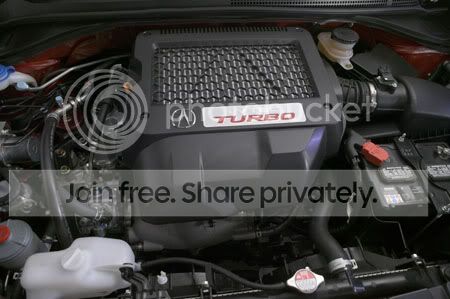
Honda’s new hefty K-Series engine provides a performance boost for SUV consumers and could possibly offer insight into Honda’s engineering forecast. Developed specifically for the RDX, Acura’s compact sport-utility, the engine has been modified to accept the strain of a turbocharger; a brand first.
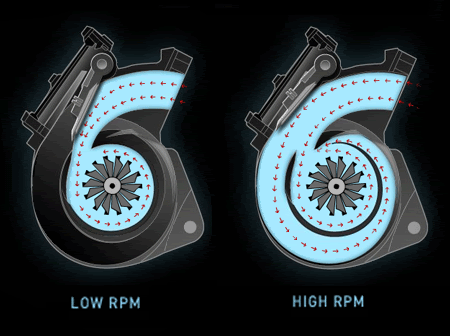
The major feature of the new system is a variable flow turbo (VFT), designed to regulate airflow with an actuator built within the turbo housing. Exhaust air is progressively directed into two main chambers, diverting air into the smaller chamber when air pressure is low, and throughout the entire system when air pressure is high. Controlled by the engine’s ECU, the computer determines the necessary level of flow to achieve efficient boost and desired power. Under these conditions, the impeller is able to spin quickly at low RPMs, eliminating relatively all turbo-lag and providing seamless force throughout the power band.
Similar attempts have been made by other manufacturers, but moving parts were often exposed to hot exhaust air, increasing repair costs and the frequency of failures. Honda’s straightforward technology places the inlet device in front of the turbine, insulated from the excessive heat, and thus substantially increasing durability.
The engine, named the K23A1, generates more torque than any other product Honda has sent to the United States, but thanks to the revolutionary i-VTEC technology the engine is respectably frugal. The potential for enthusiasts lies in the architecture, as it is closely related to the K-Series engines found in the RSX, TSX, and Civic Si. Engineers realized the additional burden they would be placing on the engine with the turbo, so the block was heavily reinforced, iron liners were added to cope with pressure and the crankshaft and connecting rods have been forged.
Due to this meaty reinforcement a direct engine swap is not possible. Nevertheless, this provides specialty equipment manufacturers with an opportunity to construct mounts and miscellaneous parts which will accommodate this engine. Given the popularity of engine swaps and the muscular structure of the K23A1, it is conceivable that enthusiasts will adopt this as their next project
In the April, 2006 edition of Super Street magazine, they ranked the “Top Ten Engines” of the last decade in regard to the compact performance industry. Honda produced three from the list: B16/B18, D16, K20. The K-Series is the most current of the bunch and should continue to be a tuner favorite, especially now that it’s available in a turbocharged version.
Sources: “Hot Swap-able?,” Sport Compact Car/Top Ten Engines,” Super Street
ACURA’S FIRST TURBO: WILL IT BOOST TUNER’S INTEREST?
Honda’s new hefty K-Series engine provides a performance boost for SUV consumers and could possibly offer insight into Honda’s engineering forecast. Developed specifically for the RDX, Acura’s compact sport-utility, the engine has been modified to accept the strain of a turbocharger; a brand first.
The major feature of the new system is a variable flow turbo (VFT), designed to regulate airflow with an actuator built within the turbo housing. Exhaust air is progressively directed into two main chambers, diverting air into the smaller chamber when air pressure is low, and throughout the entire system when air pressure is high. Controlled by the engine’s ECU, the computer determines the necessary level of flow to achieve efficient boost and desired power. Under these conditions, the impeller is able to spin quickly at low RPMs, eliminating relatively all turbo-lag and providing seamless force throughout the power band.
Similar attempts have been made by other manufacturers, but moving parts were often exposed to hot exhaust air, increasing repair costs and the frequency of failures. Honda’s straightforward technology places the inlet device in front of the turbine, insulated from the excessive heat, and thus substantially increasing durability.
The engine, named the K23A1, generates more torque than any other product Honda has sent to the United States, but thanks to the revolutionary i-VTEC technology the engine is respectably frugal. The potential for enthusiasts lies in the architecture, as it is closely related to the K-Series engines found in the RSX, TSX, and Civic Si. Engineers realized the additional burden they would be placing on the engine with the turbo, so the block was heavily reinforced, iron liners were added to cope with pressure and the crankshaft and connecting rods have been forged.
Due to this meaty reinforcement a direct engine swap is not possible. Nevertheless, this provides specialty equipment manufacturers with an opportunity to construct mounts and miscellaneous parts which will accommodate this engine. Given the popularity of engine swaps and the muscular structure of the K23A1, it is conceivable that enthusiasts will adopt this as their next project
In the April, 2006 edition of Super Street magazine, they ranked the “Top Ten Engines” of the last decade in regard to the compact performance industry. Honda produced three from the list: B16/B18, D16, K20. The K-Series is the most current of the bunch and should continue to be a tuner favorite, especially now that it’s available in a turbocharged version.
Sources: “Hot Swap-able?,” Sport Compact Car/Top Ten Engines,” Super Street


Senior Member
SL Member
Joined: May 2005
Posts: 201
How many times do I have to state this is not Honda's first turbo! 
But anyway from what I read in Road and Track, aside from the exhaust note and fuel economy the engine pretty much has the behevior of a V6, which is what engineers designing this engine pretty much aimed for. But the RDX did get some great accolades for handling, even though the probably much cheaper CX-7 comes really close. It was also designed by Honda's first female lead engineer Takashi san.
Still a nice small crossover, which would probably be a blast to tune for those who put the effort into it but it will still probably be a bit too pricey for many people's tastes.
But anyway from what I read in Road and Track, aside from the exhaust note and fuel economy the engine pretty much has the behevior of a V6, which is what engineers designing this engine pretty much aimed for. But the RDX did get some great accolades for handling, even though the probably much cheaper CX-7 comes really close. It was also designed by Honda's first female lead engineer Takashi san.
Still a nice small crossover, which would probably be a blast to tune for those who put the effort into it but it will still probably be a bit too pricey for many people's tastes.

I have come accross a Honda thread that confirm that the OEM 410cc injectors from the RDX are Plug-N-Play for the Scion tC injector clips. I have yet to confirm that these will work with the tC though. They are saturated.





Thread
Thread Starter
Forum
Replies
Last Post
my06tc
PPC: Engine / Drivetrain
10
Jun 25, 2015 12:18 AM
ptperson
Regional - Pacific Northwest
0
Feb 13, 2015 04:03 AM
TheTripleC
PPC: Vehicles
1
Jan 4, 2015 06:46 PM