


Building my own sub enclosure, Materials?


Thread Starter
Senior Member
SL Member
Joined: Apr 2007
Posts: 196
From: ny
 Building my own sub enclosure, Materials?
OK I plan on building my own subwoofer enclosure for my tc. My question is this: Is there anything worng with building my enclosure out of plywood. I know that normally mdf is used or fiberglass. I havent heard of anyone using plywood so I was wondering if it sounds bad or something. What do you guys reccomend me using?

Senior Member


SL Member
Joined: Jan 2006
Posts: 2,338
From: San Diego (Mira Mesa), CA
While mdf would be better, plywood can work well too. Use 3/4" thick or better (same as for mdf), and Baltic Birch is preferred over the more common pine or oak plywood. Standard butt-joint construction is fine if all the panels are appropriately secured and adequate internal bracing (amount depends on the size & shape of panels) is used.
Additional materials other than the mdf or plywood, power drill with 1/8" bit, 1.5" coarse-thread drywall screws, Elmer's wood glue gel (or other similar suitable glue of your choice), silicone caulking, a terminal cup or binding posts, and whatever you choose to finish the outside with (paint, or contact cement with carpet or vinyl, etc).
Pre drill all your holes or the mdf will split, and countersink the holes in plywood. Glue & screw all the panels together, and after they dry use the silicone caulking to seal all seams inside the enclosure.
I'm sure it'll be fine, especially if the box is small with no large panels. Good luck!
Additional materials other than the mdf or plywood, power drill with 1/8" bit, 1.5" coarse-thread drywall screws, Elmer's wood glue gel (or other similar suitable glue of your choice), silicone caulking, a terminal cup or binding posts, and whatever you choose to finish the outside with (paint, or contact cement with carpet or vinyl, etc).
Pre drill all your holes or the mdf will split, and countersink the holes in plywood. Glue & screw all the panels together, and after they dry use the silicone caulking to seal all seams inside the enclosure.
I'm sure it'll be fine, especially if the box is small with no large panels. Good luck!


Senior Member
SL Member
Joined: Jan 2006
Posts: 8,961
From: Team SOLO
DON'T BUY PLYWOOD
get mdf. if you don't know how to make an enclosure
http://www.icixsound.com/iv/view_vid...a09a282e0d496f
get mdf. if you don't know how to make an enclosure
http://www.icixsound.com/iv/view_vid...a09a282e0d496f

If you haven't heard of many people (or anyone?) using plywood... and everyone seems to be using mdf... why would you really want to use plywood? Do you have some crazy surplus of it lying around or something?
If you're going to build something like this, might as well do it right and spend the $$ necessary to have a quality piece.
If you're going to build something like this, might as well do it right and spend the $$ necessary to have a quality piece.
Senior Member
SL Member
Joined: Jan 2006
Posts: 2,338
From: San Diego (Mira Mesa), CA
Geez, you guys need to lighten up a bit. How many enclosures have you made from each material and how do you feel they compared? Nevermind, it's a rhetorical question, as I already know those answers.
Believe what you want, but again I'll say plywood can be fine too, mdf is preferable but not required to get outstanding performance. Just like that video from eD, it shows one good way to build a box, but that doesn't imply you can't build one of the same quality using other methods.
Believe what you want, but again I'll say plywood can be fine too, mdf is preferable but not required to get outstanding performance. Just like that video from eD, it shows one good way to build a box, but that doesn't imply you can't build one of the same quality using other methods.

Member
SL Member
Joined: Jun 2007
Posts: 97
Unless you have a surplus of plywood lying around I would go down to your local home depot or lowes and pick up a sheet of 3/4 mdf. It sells at the store for about $25.00 and is going to be way worth the small investment. Tho you do own a scion, i am sure one of your buddies has a truck to pick up the material.
One of the reasons mdf works better than plywood if because of how dense the material is. It is basically compressed sawdust glued together at 5000psi. Because of how dense this material is, it keeps the sound in and will vibrate less.
Another reason to choose MDF over plywood is because MDF will not flex as much everytime the sub hits. With the amount of pressure a box has to handle, the sides do flex out at every hit. This will actually slow down your subs speed from hitting and actually make you box have more airspace. It would be like you trying to walk on ice. Tho you do have some grip, you slip a little with every step making you slower to your destination.
Another reason MDF is used instead of plywood is MDF being a composite material it is more true to its cuts and such. I also build cabinets for a living. When i cut plywood you can see the wood actually start to curve or bend as i am cutting it on the saw. Even tho the piece seemed completely sound. As i cut the wood i am releaving the natural stress in the material. MDF does not do this as its a composite material. So you will get straighter cuts and more accurate measured cuts.
Plywood also has gaps between layers. Go to your local store and look at any sheet of plywood. I guarantee you will see gaps inbetweem layers. This inconsistincy and lack of structure is not something you would want to build your pressurized box out of.
This is my two sense of the materials at hand. As i have handeled these materials on a daily occurence for over 5 years. As for the other suggestions,
1.Yes predrill every whole or it will split
2.Fill the hole with any filler when done
3.Do not use drywall screws and they are for drywall, use a cabinet screw as they will hold tighter and not strip out as easy.
4.Usa any type of glue to seam it together and a good adhesive caulking for the corners to seal
5.Post or Caps to the wires to plug into
6. speaker carpet and contact cement (i sell kits, pm me) for the outside or paint.
If you have anyother questions please feel free to ask.
Thank you.
City-Soundz.com
One of the reasons mdf works better than plywood if because of how dense the material is. It is basically compressed sawdust glued together at 5000psi. Because of how dense this material is, it keeps the sound in and will vibrate less.
Another reason to choose MDF over plywood is because MDF will not flex as much everytime the sub hits. With the amount of pressure a box has to handle, the sides do flex out at every hit. This will actually slow down your subs speed from hitting and actually make you box have more airspace. It would be like you trying to walk on ice. Tho you do have some grip, you slip a little with every step making you slower to your destination.
Another reason MDF is used instead of plywood is MDF being a composite material it is more true to its cuts and such. I also build cabinets for a living. When i cut plywood you can see the wood actually start to curve or bend as i am cutting it on the saw. Even tho the piece seemed completely sound. As i cut the wood i am releaving the natural stress in the material. MDF does not do this as its a composite material. So you will get straighter cuts and more accurate measured cuts.
Plywood also has gaps between layers. Go to your local store and look at any sheet of plywood. I guarantee you will see gaps inbetweem layers. This inconsistincy and lack of structure is not something you would want to build your pressurized box out of.
This is my two sense of the materials at hand. As i have handeled these materials on a daily occurence for over 5 years. As for the other suggestions,
1.Yes predrill every whole or it will split
2.Fill the hole with any filler when done
3.Do not use drywall screws and they are for drywall, use a cabinet screw as they will hold tighter and not strip out as easy.
4.Usa any type of glue to seam it together and a good adhesive caulking for the corners to seal
5.Post or Caps to the wires to plug into
6. speaker carpet and contact cement (i sell kits, pm me) for the outside or paint.
If you have anyother questions please feel free to ask.
Thank you.
City-Soundz.com

Senior Member
SL Member
Joined: May 2007
Posts: 441
I've seen a lot of people build boxes out of plywood. I'm no audio expert or anything, but I'm pretty sure the main point is to be sure your box is the right size for that particular speaker and to make sure it is sealed (the seems anyway, unless your building a ported box.)
I'm pretty sure the wood isn't what makes the sound, last I checked it had more to do with amp + speaker combo...or am I wrong??
I'm pretty sure the wood isn't what makes the sound, last I checked it had more to do with amp + speaker combo...or am I wrong??
Senior Member
SL Member
Joined: May 2007
Posts: 441
Like I said, I'm not an audio expert. Not that I've ever seen a plywood box flex...but ehhh. Yeah, listen to that guy.^^
But now that I'm thinking...a sheet of MDF and a sheet of plywood run about the same price...I think the MDF is only about $7 - $10 more.
But now that I'm thinking...a sheet of MDF and a sheet of plywood run about the same price...I think the MDF is only about $7 - $10 more.
Member
SL Member
Joined: Jun 2007
Posts: 97
Originally Posted by nebster
yeah you're wrong. wood is extremely dependent on sound and how you build the box is also extremely important. mdf doesn't flex at all where as plywood and weaker woods do.

Anybody else who needs some more detail about what is quoted above, Look at my post above if you need more info about using MDF instead of plywood.
Edit: So its clear, I am agreeing with the quote above. In no way was this to be said in a rude tone. Sorry for the misunderstanding.
Member
SL Member
Joined: Jun 2007
Posts: 97
Originally Posted by nebster
or you can not be a dick
And to everyone else i am not trying to be a "dick" in anyway!
My apologies
City-Soundz.com

Senior Member
SL Member
Scinergy
Joined: Sep 2006
Posts: 487
From: Littleton, CO
Birch ply is a stronger and stiffer material than MDF. A birch ply box will flex less than a MDF constructed box. I'll let someone else explain why box flex is undesirable. Box flex can and should be minimized through the use of braces. Please see JL's page for bracing tips/tricks: http://mobile.jlaudio.com/support_pages.php?page_id=166
There are many grades of birch ply and even more grades of plywood available. Far too many to be listed here. Care must be taken when purchasing your plywood.
In general:
Birch faced ply: This is plywood faced with a birch wood veneer. The internal laminates are minimum grade spruce and birch in alternate layers.
Birch ply: All laminates are birch. Face layers are also birch. Standard number of plies for 3/4" thickness = 13
MDF: Chips about 3/4" in length from either softwoods or hardwoods are thermally softened before being past through a machine which mechanically refines the chips into bundles of fibers or individual fibers. These fibers are mixed with a synthetic resin then pressed into a sheet. The fibers are randomly arranged within the material. This mat is then pressed again whilst subjected to elevated temperatures and pressures to cure the resin and produce a sheet of the desired thickness.
Mechanical properties: In layman's terms, strength is an indication of how much load a material will withstand before failure and stiffness is how much the material will flex, or deform, when subjected to a given load.
We are not really interested in the ultimate strength of our sub boxes as they seldom fail, so the material strength is of little use. However, we are interested in how much a box will flex. Therefore, we will concentrate on the stiffness of sub box materials.
Eb = Modulus of elasticity in bending.
Eb describes how stiff a material is under bending. The higher the number, the stiffer the material is and the less it will flex. It allows us to easily compare the stiffness of different materials.
The following properties are all based on 18mm (3/4") sheet materials (Engineers know to use the friendly metric system):
Birch faced ply:-
Eb = 2700 N/mm^2 perpendicular to grain
4600 N/mm^2 parallel to grain
Density = 11.6 kg/m^2
Birch ply:-
Eb = 3400 N/mm^2 perpendicular to grain
4600 N/mm^2 parallel to grain
Density = 12.4 kg/m^2
MDF:-
Eb = 2200 N/mm^2
Density = 10.8 kg/m^2
It can be seen from the above, that the plywood properties are directional depending on the orientation of the grain. For the purposes of this analysis, we can assume the stiffest properties as sub box panels are generally supported on all four edges. MDF is a homogeneous material and the mechanical properties are identical in any direction.
Comparing the Eb values given above it can be seen that the birch based plywood is over twice as stiff as the MDF. Therefore, if two identically sized sub boxes were fabricated, one from 3/4" MDF and the other from 3/4" birch ply, the MDF box would flex twice as much as the birch ply box.
That's quite an improvement from simply using a different material for your enclosure.
Thickness vs. Material stiffness:
Birch ply is expensive and MDF is relatively cheap.
It's often asked, "Do I use 3/4" Birch ply or 1" MDF for my new sub box?"
As discussed above, birch ply is a stiffer material than MDF. It's just over twice as stiff. However, the thickness of the material has a far greater effect on the overall stiffness than the actual material stiffness.
Example: It is common to 'double up' on the baffle thickness of a sub box from 3/4" to 1.5".
You'd imagine that by doubling the thickness, you'd double the stiffness and effectively half the flex of the baffle. However, this couldn't be further from the truth…
By doubling you in fact increase the stiffness by a factor of 8. The 1.5" baffle will be 8 times stiffer than the single 3/4" baffle.
This is derived from the second moment of area of the section given by Ixx = (bd^3)/12
Where d is the depth, or thickness in this example. The thickness value is cubed to arrive at the section stiffness.
For the full increase in stiffness to be exploited, the baffles should be glued together so the two layers act together in unison under load.
A double 3/4" baffle is 8 times stiffer than a single 3/4" baffle.
A triple 3/4" baffle is 27 times stiffer than a single 3/4" baffle.
A quadruple 3/4" baffle is 64 times stiffer than a single 3/4" baffle.
And so on….
In general, the thickness of the material is key to minimize flex. The thickness will increase the stiffness far more than a stiffer material would. However, by doubling the thickness you also double the weight of the box.
For ultimate performance, the stiffer birch material should be used in multiple layers. You will then get the best of both worlds. But it is worth keeping in mind that double the layers of material and the weight of the box will also double.
As always in car audio we are faced with a compromise. Box stiffness vs. weight vs. cost.
The choice is yours.
But for someone constructing a simple 3/4" thick enclosure, Birch ply will be twice as stiff and only a fraction heavier than MDF. I know which one I'd go for and I'd double the baffle too while I was at it.
There are many grades of birch ply and even more grades of plywood available. Far too many to be listed here. Care must be taken when purchasing your plywood.
In general:
Birch faced ply: This is plywood faced with a birch wood veneer. The internal laminates are minimum grade spruce and birch in alternate layers.
Birch ply: All laminates are birch. Face layers are also birch. Standard number of plies for 3/4" thickness = 13
MDF: Chips about 3/4" in length from either softwoods or hardwoods are thermally softened before being past through a machine which mechanically refines the chips into bundles of fibers or individual fibers. These fibers are mixed with a synthetic resin then pressed into a sheet. The fibers are randomly arranged within the material. This mat is then pressed again whilst subjected to elevated temperatures and pressures to cure the resin and produce a sheet of the desired thickness.
Mechanical properties: In layman's terms, strength is an indication of how much load a material will withstand before failure and stiffness is how much the material will flex, or deform, when subjected to a given load.
We are not really interested in the ultimate strength of our sub boxes as they seldom fail, so the material strength is of little use. However, we are interested in how much a box will flex. Therefore, we will concentrate on the stiffness of sub box materials.
Eb = Modulus of elasticity in bending.
Eb describes how stiff a material is under bending. The higher the number, the stiffer the material is and the less it will flex. It allows us to easily compare the stiffness of different materials.
The following properties are all based on 18mm (3/4") sheet materials (Engineers know to use the friendly metric system):
Birch faced ply:-
Eb = 2700 N/mm^2 perpendicular to grain
4600 N/mm^2 parallel to grain
Density = 11.6 kg/m^2
Birch ply:-
Eb = 3400 N/mm^2 perpendicular to grain
4600 N/mm^2 parallel to grain
Density = 12.4 kg/m^2
MDF:-
Eb = 2200 N/mm^2
Density = 10.8 kg/m^2
It can be seen from the above, that the plywood properties are directional depending on the orientation of the grain. For the purposes of this analysis, we can assume the stiffest properties as sub box panels are generally supported on all four edges. MDF is a homogeneous material and the mechanical properties are identical in any direction.
Comparing the Eb values given above it can be seen that the birch based plywood is over twice as stiff as the MDF. Therefore, if two identically sized sub boxes were fabricated, one from 3/4" MDF and the other from 3/4" birch ply, the MDF box would flex twice as much as the birch ply box.
That's quite an improvement from simply using a different material for your enclosure.
Thickness vs. Material stiffness:
Birch ply is expensive and MDF is relatively cheap.
It's often asked, "Do I use 3/4" Birch ply or 1" MDF for my new sub box?"
As discussed above, birch ply is a stiffer material than MDF. It's just over twice as stiff. However, the thickness of the material has a far greater effect on the overall stiffness than the actual material stiffness.
Example: It is common to 'double up' on the baffle thickness of a sub box from 3/4" to 1.5".
You'd imagine that by doubling the thickness, you'd double the stiffness and effectively half the flex of the baffle. However, this couldn't be further from the truth…
By doubling you in fact increase the stiffness by a factor of 8. The 1.5" baffle will be 8 times stiffer than the single 3/4" baffle.
This is derived from the second moment of area of the section given by Ixx = (bd^3)/12
Where d is the depth, or thickness in this example. The thickness value is cubed to arrive at the section stiffness.
For the full increase in stiffness to be exploited, the baffles should be glued together so the two layers act together in unison under load.
A double 3/4" baffle is 8 times stiffer than a single 3/4" baffle.
A triple 3/4" baffle is 27 times stiffer than a single 3/4" baffle.
A quadruple 3/4" baffle is 64 times stiffer than a single 3/4" baffle.
And so on….
In general, the thickness of the material is key to minimize flex. The thickness will increase the stiffness far more than a stiffer material would. However, by doubling the thickness you also double the weight of the box.
For ultimate performance, the stiffer birch material should be used in multiple layers. You will then get the best of both worlds. But it is worth keeping in mind that double the layers of material and the weight of the box will also double.
As always in car audio we are faced with a compromise. Box stiffness vs. weight vs. cost.
The choice is yours.
But for someone constructing a simple 3/4" thick enclosure, Birch ply will be twice as stiff and only a fraction heavier than MDF. I know which one I'd go for and I'd double the baffle too while I was at it.
Thread Starter
Senior Member
SL Member
Joined: Apr 2007
Posts: 196
From: ny
Thank you guys for all the feedback! The reason I was asking is because I work in a wood shop and have tons of birch ply lying around. As I do not have a lot of expierence bulding sound enclosures I do have a lot of experience working with wood. I also do know a little about sound I build guitars and basses for a living. I also play the bass guitar, so I know how much different woods or materials can affect sound. I thought that the ply may not be optimal but thought it would work. Well I think I might go with the mdf. I have never worked with mdf b4, is it heavier than ply?

Senior Member
OhioScions
SL Member
Joined: Sep 2006
Posts: 188
From: Ohio
Cheese boxes from pizza shops work well as sub boxes..might as well use those!
(sarcasm intended...although for my first box I DID use a cheese box for a while until I could afford a box)
Like the guy said above..it all comes down to weight, cost, and stiffness.
You can also throw in workability too into that equation. I am not familiar with birch ply, but if it is like regular ply it would be a pain to look nicer. MDF is already smooth on the planes, where as the ply I have seen is usually rough. To me, it means I can do the cuts, build the box, sand, paint, carpet...etc, a box in short order.
As I started writing this I noticed you responded...if you have the stuff available to you, might as well try! Worst case would be you would have to remake a box in the future. Try it with what you have available to you and see if you like the sound. The only person the sound matters to is the person who uses it all the time. So as long as you are happy, its all good!
(sarcasm intended...although for my first box I DID use a cheese box for a while until I could afford a box)
Like the guy said above..it all comes down to weight, cost, and stiffness.
You can also throw in workability too into that equation. I am not familiar with birch ply, but if it is like regular ply it would be a pain to look nicer. MDF is already smooth on the planes, where as the ply I have seen is usually rough. To me, it means I can do the cuts, build the box, sand, paint, carpet...etc, a box in short order.
As I started writing this I noticed you responded...if you have the stuff available to you, might as well try! Worst case would be you would have to remake a box in the future. Try it with what you have available to you and see if you like the sound. The only person the sound matters to is the person who uses it all the time. So as long as you are happy, its all good!
Senior Member
OhioScions
SL Member
Joined: Sep 2006
Posts: 188
From: Ohio
I'm sure someone has better pictures of their setup...
I have only used flat black colors (forest green once) for my boxes. My choice was to keep down the reflections away from prying eyeballs where I live. If they can't see a box and see no other proof of "upgrades" they will leave me alone.
Most people put carpet on their MDF enclosures. Some put vinyl covering. Me, I am just cheap and like the flat black for the reason above.
Heres a speaker made of MDF painted black...
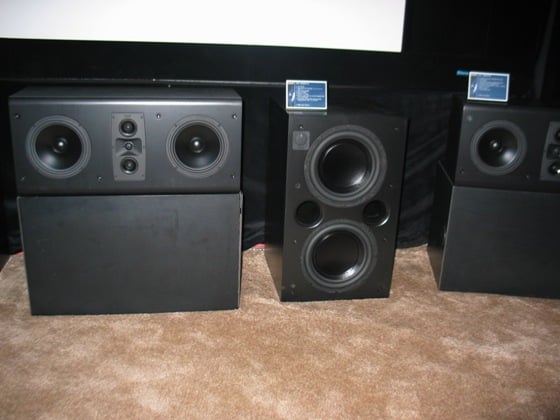
I also found this information that might be helpful compairing it to other woods...
Advantages: -There are a number of reasons why MDF may be used instead of plywood or chipboard. It is dense, flat, stiff, has no knots and is easily machined. Because it is made up of fine particles it does not have an easily recognisable surface grain. MDF can be painted to produce a smooth quality surface. Because MDF has no grain it can be cut, drilled, machined and filed without damaging the surface. MDF may be dowelled together and traditional woodwork joints may even be cut. MDF may be glued together with PVA wood glue. Oil, water-based paints and varnishes may be used on MDF. Veneers and laminates may also be used to finish MDF
Disadvantages: -MDF can be dangerous to use if the correct safety precautions are not taken. MDF contains a substance called urea formaldehyde, which may be released from the material through cutting and sanding. Urea formaldehyde may cause irritation to the eyes and lungs. Proper ventilation is required when using it and facemasks are needed when sanding or cutting MDF with machinery. The dust produced when machining MDF is very dangerous. Masks and goggles should always be worn at all times. Due to the fact that MDF contains a great deal of glue the cutting edges of your tools will blunt very quickly. MDF can be fixed together with screws and nails but the material may split if care is not taken. If you are screwing, the screws should not be any further than 25mm in from the edge. When using screws always use pilot holes. Urea formaldehyde is always being slowly released from the surface of MDF. When painting it is good idea to coat the whole of the product in order to seal in the urea formaldehyde. Wax and oil finishes may be used as finishes but they are less effective at sealing in the urea formaldehyde
I have only used flat black colors (forest green once) for my boxes. My choice was to keep down the reflections away from prying eyeballs where I live. If they can't see a box and see no other proof of "upgrades" they will leave me alone.
Most people put carpet on their MDF enclosures. Some put vinyl covering. Me, I am just cheap and like the flat black for the reason above.
Heres a speaker made of MDF painted black...
I also found this information that might be helpful compairing it to other woods...
Advantages: -There are a number of reasons why MDF may be used instead of plywood or chipboard. It is dense, flat, stiff, has no knots and is easily machined. Because it is made up of fine particles it does not have an easily recognisable surface grain. MDF can be painted to produce a smooth quality surface. Because MDF has no grain it can be cut, drilled, machined and filed without damaging the surface. MDF may be dowelled together and traditional woodwork joints may even be cut. MDF may be glued together with PVA wood glue. Oil, water-based paints and varnishes may be used on MDF. Veneers and laminates may also be used to finish MDF
Disadvantages: -MDF can be dangerous to use if the correct safety precautions are not taken. MDF contains a substance called urea formaldehyde, which may be released from the material through cutting and sanding. Urea formaldehyde may cause irritation to the eyes and lungs. Proper ventilation is required when using it and facemasks are needed when sanding or cutting MDF with machinery. The dust produced when machining MDF is very dangerous. Masks and goggles should always be worn at all times. Due to the fact that MDF contains a great deal of glue the cutting edges of your tools will blunt very quickly. MDF can be fixed together with screws and nails but the material may split if care is not taken. If you are screwing, the screws should not be any further than 25mm in from the edge. When using screws always use pilot holes. Urea formaldehyde is always being slowly released from the surface of MDF. When painting it is good idea to coat the whole of the product in order to seal in the urea formaldehyde. Wax and oil finishes may be used as finishes but they are less effective at sealing in the urea formaldehyde
Senior Member
SL Member
Joined: Jan 2006
Posts: 2,338
From: San Diego (Mira Mesa), CA
Originally Posted by rocketgyrl
Birch ply is a stronger and stiffer material than MDF. A birch ply box will flex less than a MDF constructed box.
But for someone constructing a simple 3/4" thick enclosure, Birch ply will be twice as stiff and only a fraction heavier than MDF. I know which one I'd go for and I'd double the baffle too while I was at it.
But for someone constructing a simple 3/4" thick enclosure, Birch ply will be twice as stiff and only a fraction heavier than MDF. I know which one I'd go for and I'd double the baffle too while I was at it.
Thanks for that Robyn! I was so outnumbered by the "mdf-only" crowd that I wasn't inclined to discuss the topic further, but I hope your post gave them some food for thought.

Thread
Thread Starter
Forum
Replies
Last Post
Wrencher
Scion xB 1st-Gen Owners Lounge
1
Jul 29, 2015 01:38 PM
