


LIGHTS STILL DIM!!!


Senior Member


SL Member
Joined: Apr 2007
Posts: 845

I just did the big 3 and it did nothing for me 
0ga all around. battery to chassis ground, chassis to block and power from battery to alt (fused for my own safety)
The amps ground is the rear passenger seat belt,scrapped up to remove paint
The car idles at 14.5 but when I really turn it up the voltage goes down to 13.8-13.7
as long as the volume is about mid everything is ok and no dimming.
but I didnt notice any thing above half volume where it really matters to me
I do a ton of highway driving with the windows down
my only amp is a nine.1 which can pull up to 120amps
0ga all around. battery to chassis ground, chassis to block and power from battery to alt (fused for my own safety)
The amps ground is the rear passenger seat belt,scrapped up to remove paint
The car idles at 14.5 but when I really turn it up the voltage goes down to 13.8-13.7
as long as the volume is about mid everything is ok and no dimming.
but I didnt notice any thing above half volume where it really matters to me
I do a ton of highway driving with the windows down
my only amp is a nine.1 which can pull up to 120amps

Senior Member
SL Member
Joined: Nov 2007
Posts: 1,147
From: Hialeah, FL
time to add an extra battery to your electrical system, , and 120amps is what our stock alt puts out or roughtly 1200watts, personal prefrence if your jsut into daily loud driving a pair of kenetic hc1800's would do you good, one under the hood, and one in the back, i had a pair of optimas when i had my 86 fire bird, red top under the hood and a blue top in the rear, and id still dim a bit, heck i still have that blue top lol
Senior Member
SL Member
Joined: Nov 2007
Posts: 1,147
From: Hialeah, FL
Originally Posted by nebster
a new battery is NOT NECESSARY.
READ THE DAMN THREAD
READ THE DAMN THREAD
^^^alrighty **** hat
Originally Posted by DjTwitcH
Well i got a capacitor and my DAMN lights still dim. wtf could be the problem. oh ya... im using the stock '08 battery, 4 gauge amp kit, 1200 watt profile amp and the capacitor is a 1.5 FD.
Anybody gotta clue?
Anybody gotta clue?
the op stated that he has a 1200watt amp be it rms or max wattage lets see 1200 watts/ 12 volts = what? 100amps, ok so his amp is drawing 100amps from a 120amp alternator, that leaves only 20amps to support the rest of the stock electrical.
seriously i dont know everything, but damn comon sence over here or is reading > than me once again?
Originally Posted by DjTwitcH
Well i got a capacitor and my DAMN lights still dim. wtf could be the problem. oh ya... im using the stock '08 battery, 4 gauge amp kit, 1200 watt profile amp and the capacitor is a 1.5 FD.
Anybody gotta clue?
Anybody gotta clue?
read my initial post, then follow up on what i posted below
i shall now repost some info from my favorite car audio site, realm of excursion hope thats ok with the OP
c&p start here
Determining the current capabilities of your vehicle.
Before installing a power amplifier in your system you should take into consideration the vehicle’s ability to provide adequate current to the amplifier. In most vehicles, the alternator is only capable of supplying a little over the requirements for the standard electrical system (i.e. headlights, air conditioning, etc.).
How you play your system will determine the amount of current you will need. For example if you listen to your system at low listening levels, then you’ll probably use less than one-third the rated current draw. If you play your system loud, then you will use most of the rated current of the amplifier.
Most alternators have about a 40 percent reserve capability. In order to determine how many in amperes of current you will have for your system; you will need to find out alternator rating. If you’re not sure of the total amperage of your alternator, a good place to look is on the alternator itself. Most alternators have a metal tag stating the total average available. If you can’t find the tag, check with the manufacture to find out the rated amperage. Once rated current of the alternator is determined, you need to multiply this number by .40 in order to determine the reserve current available for use with your power amplifier.
For Example:
Alternator = 80 Amps 80 x .40 = 32 Amps
Please keep in mind this is an estimate only and not exact science. It is best to get your electrical system tested by a professional to determine the electrical system's true capabilities.
Calculating Amplifier Current Demands
By using the fuse value of the amplifier you can get a rough idea of the amount of current draw that will be used under full output power. Although the full output rating is good to determine the total amperage draw in the system, it does not represent the true continuous or averaged amperage draw in the system. Listed below is a simple way to determine the approximate continuous current draw of your amplifier.
1.) Determine fuse value of the amplifier.
2.) Divide the RMS power Rating by the Peak power rating.
Example:
50Watts RMS Divided by 100 Watts Peak Power = .50 (50%)
Once you figure the percentage of RMS vs. Peak power, you multiply the fuse value of the amplifier by the RMS percentage.
Example:
If the amplifiers fuse value was 30A, then 30A multiplied by 50% would be 15A of continuous current draw.
Upgrading your Electrical System
Depending on systems current requirements vs. your electrical systemss capabilities, you may need to upgrade your electrical system. For example, if you find that your headlights dim when you have your system cranked up at night, this is a sign you should upgrade your electrical system.
There are several different ways to accomplish this. One way is to upgrade the alternator so that it has higher amperage output. Another way is to purchase a Capacitor. We recommend that you consult your Car Audio Retailer to determine what is best for your system.
Charging System Basics:
The electrical system in an automobile is said to be a 12 volt system, but this is slightly misleading. The charging system in most cars will generally produce a voltage between 13.5 and 14.4 volts while the engine is running. It has to generate more voltage than the battery's rated voltage to overcome the internal resistance of the battery. This may seem strange, but the current needed to recharge the battery would not flow at all if the charging system's output voltage was the same as the battery voltage. A greater difference of potential (voltage) between the battery's voltage and the alternator's output voltage will provide a faster charging rate.
As long as the engine is running, all of the power for the accessories is delivered by the alternator. The battery is actually a load on the charging system. The only time that the battery would supply power with the engine running is when the current capacity of the alternator is exceeded or when engine is at a very low idle.
--------------------------------------------------------------------------------
Alternator Basics
Overview:
A basic alternator has 2 main electrical components. The rotor and the stator. The rotor is the part of the alternator that is spun by the drive belt. There are a group of electrical field coils mounted on the rotor. The stator is the group of stationary coils that line the perimeter of the inside of the alternator case. When current (supplied by the voltage regulator - to be explained later) is flowing in the rotor's coils, they induce current flow in the stationary coils. The induced current (and voltage) is an AC current. To convert this to DC, the current is passed through a bridge rectifier.
Stator and Rotor in Action:
In the following diagram, you can see three crudely drawn sets of rotors and stators. In the leftmost diagram (marked 'A'), you can see the rotor's coil approaching the stator coil. As the rotor coil approaches the stator coil, it induces current flow in the stator coils. This causes an increase in output voltage. As it approaches the position where the coils' centers are aligned ('B'), there is no induced current. When the coils move away from each other ('C') the induced current flows in the opposite direction and the generated voltage is negative.
--------------------------------------------------------------------------------
Rectification:
You should have noticed that the generated voltage was AC. You already know that a vehicle's charging system needs to produce DC to recharge the battery. This is done with diodes. The following diagram shows a simple transformer and a bridge rectifier. The transformer is driven with a sine wave (similar to that produced in each stator coil). Since the transformer is driven with a sine wave, the output of the transformer is a sine wave (similar to the one shown). The sine wave is driven into the bridge rectifier and the output is a pulsed DC waveform.
Bridge rectifier:
You should also realize that there are 3 different groups of stator coils in an alternator (not shown in diagrams). The rectification is much like the simple transformer shown above but in the place of a single transformer winding there are 3 windings. It also uses 6 diodes instead of 4.
3 Phase:
The following diagram shows the 3 different phases from the 3 groups of stator windings. The three phases of AC are shown in three different colors. The next set of lines shows the rectified waveforms overlapped. The bottom waveform (white line) is what the rectified voltage would actually look like if viewed on an oscilloscope. Connecting the battery to the alternator will smooth the white line even more.
--------------------------------------------------------------------------------
Alternator Schematic:
The following is a generic schematic showing the stator windings and the bridge rectifier. You also see a diode trio. the diode trio takes part of the output and sends it to the voltage regulator. The output diodes are the rectifiers that rectify the AC and supply power to your electrical accessories.
--------------------------------------------------------------------------------
Brushes and Slip Rings:
For an alternator to produce electrical current, there needs to be some excitation current flowing in the rotor windings. Since the rotor is spinning, you can't just connect a couple of wires to it (cause they'd just be twisted off Smile. To make the electrical connection, slip rings and brushes are used. The slip rings are fixed to the shaft of the rotor. The brushes are fixed to the stationary part of the alternator. The brushes, which are generally made of carbon, are spring loaded to keep constant pressure on the slip rings as the brushes wear down. The following diagram shows the general location of the rotor and the associated parts.
--------------------------------------------------------------------------------
Voltage Reguation:
As you already know from the 'wire' page, all wire has resistance. You also know that when you have current flow through a resistive element (wire), there will be a voltage loss. If the current draw from the charging system was constant, there would be no need for a voltage regulator. If there was no loss, the design engineer would simply design the alternator to produce a given voltage. This won't work with a car audio system because the current draw is anything but constant. This means that the alternator needs a compensating voltage regulator. The voltage regulator controls the flow of current in the rotor's windings. The voltage regulator's output current will typically be between 0 amps (with little or no current draw) and 5 amps (at maximum current draw). The regulator can vary the current flow infinitely to keep the voltage precisely at the target voltage. Generally the regulator is built into the alternator. There are some high current/special use alternators which may have external regulators. Some of the external regulators are adjustable via a potentiometer.
--------------------------------------------------------------------------------
Current demand and flow:
If you have an alternator that can produce 120 amps of current (max) and the the total current demand from the electrical accessories (including the battery) is only 20 amps, the alternator will only produce the necessary current (20 amps) to maintain the target voltage (which is determined by the alternator's internal voltage regulator). Remember that the alternator monitors the electrical system's voltage. If the voltage starts to fall below the target voltage (approximately 13.8 volts depending on the alternator's design), the alternator produces more current to keep the voltage up. When the demand for current is low, the full current capacity of the alternator is not used/produced (a 120 amp alternator does not continuously produce 120 amps unless there is a sufficient current draw).
Dimming lights:
When you play your system at very high volumes and the lights on your vehicle dim slightly, it generally means that your alternator can not supply enough current for all of your electrical accessories (including your amplifiers). If you play a long bass note/tone and the lights get dim and stay dim until the note is over, your alternator clearly can not keep up with the current demand. If, on a long bass note, the lights dim just for a fraction of a second but return to their original brightness while the note/tone is still playing, the alternator's regulator may just be a little slow in reacting to the voltage drop. Since the lights return to their original brightness during the bass note, the alternator is able to supply the current needed by your power your amplifiers and other electrical accessories.
--------------------------------------------------------------------------------
Warning!
Some people tell you that you can check your alternator by disconnecting it from the battery to see if the alternator can produce enough current to keep the engine running. BAD IDEA! Disconnecting the battery will subject the voltage regulator (and computer and audio equipment...) to significant voltage spikes which may cause an otherwise good alternator to fail. Even if there were no damaging spikes, this test would not indicate whether or not the alternator was good because the engine will easily run with a weak or failing alternator.
Simple Test:
If you want to see if your alternator is producing current, turn on your headlights when you're parked and the engine idling with the headlights shining on a wall (at night). Notice how bright they are. Then turn the engine off. The lights should get dimmer when you turn the engine off. If the lights get brighter when you kill the engine, the alternator was not charging sufficiently. When doing this test, the lights should be the only load (turn the stereo, a/c and other accessories off). With a heavy load, an otherwise good alternator may not be able to produce sufficient amounts of current at idle.
--------------------------------------------------------------------------------
Basic Battery Information
Battery Construction:
A standard 12 volt cranking battery has 6 individual cells. Each cell is designed to produce ~2.1 volts. The cells are connected in series for a total of about 12.5 volts. Each cell basically consists of 1 set of lead plates and 1 set of lead plates coated with lead dioxide submerged in a sulfuric acid electrolytic solution.
Electrolyte Levels:
The level of the electrolyte should be about 1/8" below the bottom of the filling wells. If the electrolyte is above the bottom of the well, it may be forced out when the battery is charged. If the electrolyte is allowed to fall to below the top of the plates, the battery will be damaged. If the level of the electrolyte is low, refill it with distilled water only. Regular tap water has minerals which may coat the plates and reduce the battery's capacity.
Distilled Water:
Distilled water is water that's been heated to cause it to evaporate into water vapor. The water vapor is then condensed back into liquid water. The distilled water is free of all impurities including minerals that would coat the plates of the battery and therefore reduce its capacity to produce electrical current.
Cranking Amps:
Cranking amps is the spec that tells you how much current a battery can produce for 30 seconds at a temperature of 32° F and not have the voltage on any of the individual cells drop below 1.2 volts (7.2 volts for a 6 cell automotive battery). This may also be known as MCA or marine cranking amps.
Cold Cranking Amps:
This is the same test as cranking amps but is done at 0° F. The CCA spec is especially important if you live in a really cold climate. Since the chemical reaction that produces electrical current in the battery slows down as the temperature drops, the battery can produce less current at colder temperatures (especially below freezing). When comparing the current capacity of batteries, make sure that you have some standards to qualify the current ratings. If you see the current rating without CA or CCA, you don't know how the battery was tested and the current rating is virtually useless.
Reserve Capacity:
The reserve capacity is the time that a battery can produce 25 amps at 80° F before the individual cell voltage drops below 1.75 volts (10.5 volts for a 6 cell automotive battery).
Deep Cycle vs Standard Battery:
A normal lead-acid battery will be damaged if it is completely drained (even if it's only one time).
A deep cycle battery is designed to survive being drained multiple times.
Deep cycle batteries have more reserve capacity but have less cranking amps for a given size.
A standard battery would have more total surface area on its plates when compared to a deep cycle battery of equal size. This extra surface area provides more area for the chemical reaction to take place and therefore produce a higher output current.
The electrolyte in a deep cycle will be a slightly more concentrated sulfuric acid than a standard battery.
Gel-cell Batteries:
Gel-cell batteries use a thickened (gelled) electrolyte that will not leak out like a liquid electrolyte. Many of them can be mounted in virtually any position. These batteries may be suitable for some applications but for engine starting, other batteries should be used. Gel-cell batteries can not produce as much current for long periods of time as standard liquid electrolye batteries.
Recombinant Gas Batteries:
RG batteries have only 2 long thin plates per cell. They are constructed much like an electrolytic capacitor. The plates are separated by a fiberglass mat material designed to hold the electrolyte. These long thin plates have significant amounts of surface area (compared to standard batteries). This extra surface area allows the battery to produce significantly more current than standard batteries of similar physical size. Optima® is one manufacturer of RG batteries. If you're going to add batteries to your system and the batteries will be in the vehicle's trunk or passenger compartment, RG batteries won't vent flammable hydrogen gas or corrosive gasses into the vehicle.
Senior Member
SL Member
Joined: Nov 2007
Posts: 1,147
From: Hialeah, FL
Use this chart to determine an appropiate wire guage. Thanks to Memphis Car Audio for the creating the chart and scionxb for finding it.
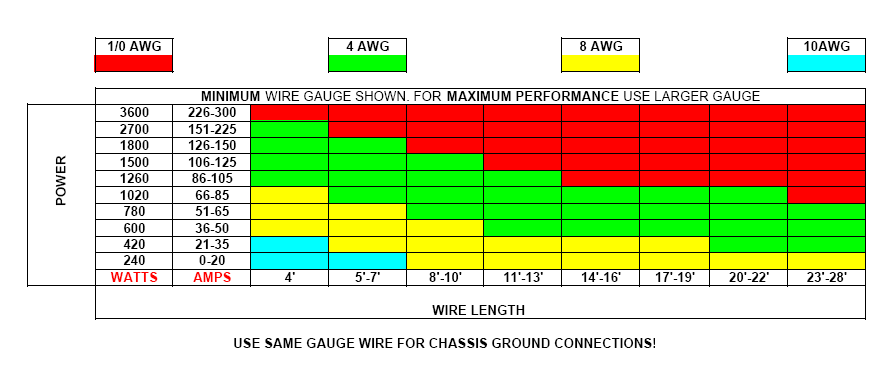
This chart can also be downloaded in a PDF format from Memphis Car Audio:
http://memphiscaraudio.com/LiveImage...ocumentURL.pdf
To figure out which gauge wire to use, determine how many watts rms will be used per power run. If you use a distribution block, you have to account for all of amps being used for the input power run. After you find the total watts rms, locate number on the chart that's just above your total. So if your total watts rms is 1600, use the 1800. Then figure out how long of power run you will need. You will now know the appropriate size gauge to use.
This chart can also be downloaded in a PDF format from Memphis Car Audio:
http://memphiscaraudio.com/LiveImage...ocumentURL.pdf
To figure out which gauge wire to use, determine how many watts rms will be used per power run. If you use a distribution block, you have to account for all of amps being used for the input power run. After you find the total watts rms, locate number on the chart that's just above your total. So if your total watts rms is 1600, use the 1800. Then figure out how long of power run you will need. You will now know the appropriate size gauge to use.

Senior Member
SL Member
Joined: Aug 2006
Posts: 2,434
From: Hyde Park, NY
Originally Posted by combatsteve
Originally Posted by Tcguy85
i just don't agree with really anything you say. i have 1200+ watts, and i listen to my system at pretty high volumes and get almost no dimming at all. and i know for a fact at time i am pushing A LOT of power out of my amps. the teeny tiny bit of dimming i get is no big deal. wouldn't notice it unless you were really looking for it. i do not expect to have any problems running this kind of power in my car.
you're also the guy that tried telling me because i have an underlap in between the crossover points on my tweeters and mids that i will be "missing" information in that range which is not true. i proved it to you and you still disagreed.
so i think YOU do not know what you are talking about.
you're also the guy that tried telling me because i have an underlap in between the crossover points on my tweeters and mids that i will be "missing" information in that range which is not true. i proved it to you and you still disagreed.
so i think YOU do not know what you are talking about.
Oh yeah and PS YOU ARE NOT ALWAYS RIGHT SO STOP ACTING LIKE IT.
Now my apology to the thread starter for this nonsense.
anyway..... since you say the big 3 will do nothing in any situation for anybody then what do you suggest the OP does? what does he need to do or buy?
Senior Member
SL Member
Joined: Aug 2006
Posts: 2,434
From: Hyde Park, NY
yup, if i did the big 3 in my car and i say it made a difference, then it did. why would i make it up?
am i saying it makes a difference in every bodies install? no, i did not. but anybody who knows anything will tell you that doing the big 3 will yield much greater results than adding a capacitor to your car. the only place they belong in cars is in crossover networks and inside of amps.
also if i electronically have a gap in my crossovers and it sounds great, why would i make that up as well? there is a HUGE difference between electronically having a gap and acoustically having a gap. i could plot you out a graph of what my frequency response looks like on paper but that does mean my car will RTA the same? no.
that is all.
am i saying it makes a difference in every bodies install? no, i did not. but anybody who knows anything will tell you that doing the big 3 will yield much greater results than adding a capacitor to your car. the only place they belong in cars is in crossover networks and inside of amps.
also if i electronically have a gap in my crossovers and it sounds great, why would i make that up as well? there is a HUGE difference between electronically having a gap and acoustically having a gap. i could plot you out a graph of what my frequency response looks like on paper but that does mean my car will RTA the same? no.
that is all.

Senior Member
SL Member
Scinergy
Joined: Sep 2006
Posts: 487
From: Littleton, CO
Originally Posted by ACiDTc
time to add an extra battery to your electrical system,
Originally Posted by ACiDTc
and 120amps is what our stock alt puts out or roughtly 1200watts
Originally Posted by ACiDTc
personal prefrence if your jsut into daily loud driving a pair of kenetic hc1800's would do you good, one under the hood, and one in the back, i had a pair of optimas when i had my 86 fire bird, red top under the hood and a blue top in the rear, and id still dim a bit, heck i still have that blue top lol
Since you decided to post a book, and disregarded the information already posted in this thread, here's a reading assignment for you: https://www.scionlife.com/forums/vie...getting+sapped
I've gone into great depth about the Scion's electrical system, amplifier/system electrical demands, alternators, batteries, etc. I suggest you don't come in here and post some *help* without going through the thread...
Senior Member
SL Member
Joined: Nov 2007
Posts: 1,147
From: Hialeah, FL
Originally Posted by rocketgyrl
Originally Posted by ACiDTc
time to add an extra battery to your electrical system,
Originally Posted by ACiDTc
and 120amps is what our stock alt puts out or roughtly 1200watts
Originally Posted by ACiDTc
personal prefrence if your jsut into daily loud driving a pair of kenetic hc1800's would do you good, one under the hood, and one in the back, i had a pair of optimas when i had my 86 fire bird, red top under the hood and a blue top in the rear, and id still dim a bit, heck i still have that blue top lol
Since you decided to post a book, and disregarded the information already posted in this thread, here's a reading assignment for you: https://www.scionlife.com/forums/vie...getting+sapped
I've gone into great depth about the Scion's electrical system, amplifier/system electrical demands, alternators, batteries, etc. I suggest you don't come in here and post some *help* without going through the thread...
i notice your a
2006 USACi Sound Quality World Champion
2007 IASCA/NOPI Regional Sound Quality Champion
as per your sig, and i take it you have seen spl setups running of stock and even ho alts, what do the battery banks look like 2, 3, 4,5 batterys supporting te electrical system?
my help comes form exp as i do local spl comps and prior to my scion tc i had a 1986 firebird with an OEM alt that put out 80amps, did the big 3 and regrouned everything with 0gauge, and i would still dim like the dickens my amp draws atleast 50amps, leaving 30 for the clunker and its shotty electrical system.
so my info may be a book, but lets say the OP does do the big 3 as EVERYONES'S suggesting, but lets say he does it, and his lights still dim what then?
serious suggestion for the OP, and from what ive read so far actual relavent information.
big 3 wont hurt, but you need some sort of extra support for your electrical system or your gonna toast your alternator
my opinion, toss the factory batt, and get a high capacity battery, be it an optima yellow top, or a kinetic hc 1800 in my opinion either of those will help support your current set up....and toss the cap
acidtc


Senior Member

SL Member
Joined: Jan 2006
Posts: 8,961
From: Team SOLO
Originally Posted by ACiDTc
serious suggestion for the OP, and from what ive read so far actual relavent information.
big 3 wont hurt, but you need some sort of extra support for your electrical system or your gonna toast your alternator
my opinion, toss the factory batt, and get a high capacity battery, be it an optima yellow top, or a kinetic hc 1800 in my opinion either of those will help support your current set up....and toss the cap
acidtc
big 3 wont hurt, but you need some sort of extra support for your electrical system or your gonna toast your alternator
my opinion, toss the factory batt, and get a high capacity battery, be it an optima yellow top, or a kinetic hc 1800 in my opinion either of those will help support your current set up....and toss the cap
acidtc
Senior Member
SL Member
Joined: Aug 2006
Posts: 2,434
From: Hyde Park, NY
Originally Posted by nebster
Originally Posted by ACiDTc
serious suggestion for the OP, and from what ive read so far actual relavent information.
big 3 wont hurt, but you need some sort of extra support for your electrical system or your gonna toast your alternator
my opinion, toss the factory batt, and get a high capacity battery, be it an optima yellow top, or a kinetic hc 1800 in my opinion either of those will help support your current set up....and toss the cap
acidtc
big 3 wont hurt, but you need some sort of extra support for your electrical system or your gonna toast your alternator
my opinion, toss the factory batt, and get a high capacity battery, be it an optima yellow top, or a kinetic hc 1800 in my opinion either of those will help support your current set up....and toss the cap
acidtc

Senior Member
Strictly Scionized
SL Member
Joined: Oct 2004
Posts: 1,284
From: White Marsh, Balti Co., MD
Originally Posted by nebster
Originally Posted by ACiDTc
serious suggestion for the OP, and from what ive read so far actual relavent information.
big 3 wont hurt, but you need some sort of extra support for your electrical system or your gonna toast your alternator
my opinion, toss the factory batt, and get a high capacity battery, be it an optima yellow top, or a kinetic hc 1800 in my opinion either of those will help support your current set up....and toss the cap
acidtc
big 3 wont hurt, but you need some sort of extra support for your electrical system or your gonna toast your alternator
my opinion, toss the factory batt, and get a high capacity battery, be it an optima yellow top, or a kinetic hc 1800 in my opinion either of those will help support your current set up....and toss the cap
acidtc
Senior Member
SL Member
Scinergy
Joined: Sep 2006
Posts: 487
From: Littleton, CO
Originally Posted by ACiDTc
serious suggestion for the OP, and from what ive read so far actual relavent information.
big 3 wont hurt, but you need some sort of extra support for your electrical system or your gonna toast your alternator
my opinion, toss the factory batt, and get a high capacity battery, be it an optima yellow top, or a kinetic hc 1800 in my opinion either of those will help support your current set up....and toss the cap
acidtc
big 3 wont hurt, but you need some sort of extra support for your electrical system or your gonna toast your alternator
my opinion, toss the factory batt, and get a high capacity battery, be it an optima yellow top, or a kinetic hc 1800 in my opinion either of those will help support your current set up....and toss the cap
acidtc
Imagine a cup of water is your OEM battery, and a pitcher is your "high capacity battery" (I think you mean: deep cycle). Your only method to get the liquid into your stomach is a straw. Do you really think the pitcher is going to be able to quench your thirst FASTER??? Keep in mind, I will (as the alternator) refill your cup as many times as you like, but I have other "customers" (electrical demands), and it might take me a while.
Clearly this is an issue of supply and demand. One's electrical system can only exceed the limitations of the alternator, for a duration of the battery's storage. When the load is in excess of this (rarely, if ever), compromises must be made. Lights will not have 100% illumination, etc. The first goal of anyone going beyond the OEM's design goals, is to aid what is already there by lowering resistance (re: big-3).
I'm not sure what you mean by "support" in terms of the alternator. It is the sole energy providing device! The larger battery makes NO difference with the LOAD of the system!