


Noob question about adding a subwoofer


Member

SL Member
Joined: Jan 2006
Posts: 49

http://www.edesignaudio.com/edv2/pro...products_id=45
Sorry, it is an amp and I thought it was pretty common knowledge who eD was since they sponsor this site
Sorry, it is an amp and I thought it was pretty common knowledge who eD was since they sponsor this site

Senior Member

Team ScionEyed
SL Member
Joined: Dec 2006
Posts: 1,092
From: Siloam Springs, AR
Hmmm... looks like I am a little behind on the amp scene. 
You know, just as you say that, I look in the top right hand corner and there it is... Elemental Designs. Should have said that, I would have understood. LoL.
Thanks for the link.
You know, just as you say that, I look in the top right hand corner and there it is... Elemental Designs. Should have said that, I would have understood. LoL.
Thanks for the link.

Thread Starter
Senior Member
SL Member
Team ScioNRG
Joined: Jan 2006
Posts: 275
From: NJ
unfortunately my choices are limited to what is available at best buy.
the stock sound system is rated at 160 watts, is that peak or rms ? i'm a bit confused, with the tweeters how many watts is my system producing now with stock speakers and kenwood headunit?
the stock sound system is rated at 160 watts, is that peak or rms ? i'm a bit confused, with the tweeters how many watts is my system producing now with stock speakers and kenwood headunit?
Senior Member
Team ScionEyed
SL Member
Joined: Dec 2006
Posts: 1,092
From: Siloam Springs, AR
If you have a rating, and it's not specifically stated "RMS", then it's generally peak. Like I said before, peak is good for a number to just throw out there. It's a real rating, but hardly what you will actually hear. And, it's generally higher than RMS, so for a sale point of view, you would want to use peak.
It's hard to "tell" how many watts your system is producing, as if it were something that you could hear. You can rate the sound in SPL (sound pressure level... I think), and/or db (Decibels). But it's pretty hard to hear a system and be like "Oh yeah, that 600 watts RMS right there!".
If your stereo is rated at 160 watts (peak), then it's probably producing that. The addition and removal of speakers may change the wattage out at each point (or each speaker) but shouldn't change the overall wattage produced. 160 watts is still 160 watts.
It's hard to "tell" how many watts your system is producing, as if it were something that you could hear. You can rate the sound in SPL (sound pressure level... I think), and/or db (Decibels). But it's pretty hard to hear a system and be like "Oh yeah, that 600 watts RMS right there!".
If your stereo is rated at 160 watts (peak), then it's probably producing that. The addition and removal of speakers may change the wattage out at each point (or each speaker) but shouldn't change the overall wattage produced. 160 watts is still 160 watts.

Senior Member


SL Member
Joined: Jul 2005
Posts: 1,099
From: ...Lost Somewhere in Time
Originally Posted by Amoxapine
Here is the kicker... Ohms. Ohms are the measurement of resistance in the sub or amp. Because Ohms are resistance, for the loudest system possible, you would want the lowerest measured ohms... You can get them down to 1 (maybe lower, but I haven't seen any), but those are generally going to be pretty high dollar. 2 ohms are good as well, but again, those tend to start getting high dollar. For the most part, what you will find in best buy or wal-mart is going to be around 4 ohms, and sometimes 2.
When hooking your sub up to you amp, you want the sub and amp to not only have the right amount of power, but the right ohms. Why you ask? Because if the amp and sub match in power, but not in resistance, you will be pulling too much from the amp (making it hot) or giving too much to the sub, (making it distorted).
When hooking your sub up to you amp, you want the sub and amp to not only have the right amount of power, but the right ohms. Why you ask? Because if the amp and sub match in power, but not in resistance, you will be pulling too much from the amp (making it hot) or giving too much to the sub, (making it distorted).
The impedance of speakers and the impedance the amplifier "sees" can be totally different. Wiring schemes play a MAJOR role in how much output an amplifier has on a certain setup of speakers.
For instance, two single coil 4-ohm woofers wired together in series will have a final impedance (what the amplifier "sees") of 8 ohms.
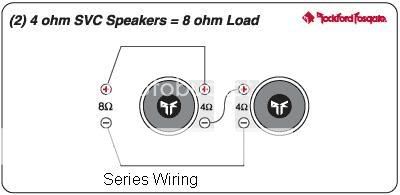
Those same two single coil 4-ohm woofers wired together in parallel will have a final impedance of 2 ohms.

"Why is this important?" you ask.
Every time you drop the impedance in half, you will double the power output. So, an amplifier that puts out 100 watts RMS at 4 ohms would only put out 50 watts RMS to the woofer setup in series, while the same amplifier on the same setup of woofers would put out 200 watts RMS if they were wired parallel.
Running an amplifier at too low an impedance can and WILL damage the amp. The amplifier will attempt to provide the circuit with the correct amount of power until the circuit is broken, either by damage to the woofers, the amplifier tripping its protection circuit, blowing a fuse, or cooking a transistor.
Ultimately, when setting up your subwoofer setup in the car, you need to have an idea how the woofers are going to be wired, the final impedance of the load, the amount of power the setup can handle, and the amount of power the chosen amplification can put out safely. Simply slapping components together will not provide you with a good quality sound system and, more than likely, will cost you a good deal of $$$ in repair bills for damaged equipment.
By no means am I calling you out, Amoxapine. I just want to ensure that someone doesn't misinterpret your post, pick the wrong equipment, fry electronics, and then blame the advice they received on SL for their misery and repair costs.
If anyone has any questions involving this sort of information, don't hesitate to ask. I would much rather see a few people get blasted by a few others for not using the "Search" button than read posts involving bad days, cooked equipment, and you out big $$$ because of some misinterpreted information.
As for the two listed Alpine woofers, both are dual-voice-coil woofers. Each coil is 4 ohms, so each woofer can be wired to a 2 ohm load (parallel) or an 8 ohm load (series). If it were me, I would choose the 10 over the 12 if the intention is to load the woofer into an under-seat enclosure simply because the 10 would perform better in a smaller enclosure than the 12. As for amplification, you should be looking for an amplifier than produces 500W RMS at 2 ohm. Be careful with your gain control and avoid distortion.
Senior Member
Team ScionEyed
SL Member
Joined: Dec 2006
Posts: 1,092
From: Siloam Springs, AR
^^ I agree, and I don't think you are calling me out.  Actually, thanks for adding to it!
You must be careful with things that you learn about a stereo. Even the most experienced person can mess up with a calculation and cause some damage. Obviously, experience does drastically improve your chances of a successful install, but everyone messes up occasionally (though usually when a professional messes up, it's something easily fixed).
I was shooting for the most basic concept of watts and ohms. UV7 has very very good information, and it should be heeded.
I suggest that if you are looking for more than your basic "What should a noob get for a stereo" and you don't want a professional to pick it and install it for you, then you get a book and read up a bit. Or, like UV7 said, get blasted for asking a stupid question or not using the search button.
It's better safe than sorry.
Actually, thanks for adding to it!You must be careful with things that you learn about a stereo. Even the most experienced person can mess up with a calculation and cause some damage. Obviously, experience does drastically improve your chances of a successful install, but everyone messes up occasionally (though usually when a professional messes up, it's something easily fixed).
I was shooting for the most basic concept of watts and ohms. UV7 has very very good information, and it should be heeded.
I suggest that if you are looking for more than your basic "What should a noob get for a stereo" and you don't want a professional to pick it and install it for you, then you get a book and read up a bit. Or, like UV7 said, get blasted for asking a stupid question or not using the search button.
It's better safe than sorry.

Thread
Thread Starter
Forum
Replies
Last Post
bootlgr
Scion xA/xB 1st-Gen ICE & Interior
1
Jan 26, 2016 01:22 AM
