


Throttle body spacer


There's enough FUD around without adding to it by making claims without reasonably verifying them (testing the affect of mods one at a time). You may have verified properly on the hemi, but clearly not with the xB2. Would you be happy with people recommending mods to you without pointing out you may not get the same result unless you make other changes at the very same time? And if they did wouldn't you want to know which mod actually made what difference? After all, it would be your personal time and money at risk!
Personally, after seeing the results from Fred's TB P&P, I was interested in trying a smooth bore TBS to see what affect it would have. My interest stemmed from two thoughts: 1) The P&P definitely reduced TB turbulence, and increasing the distance from the intake plenum would provide more opportunity for residual throttle plate/body generated turbulence to subside before hitting the plenum. 2) A smooth bore TBS effectively incrementally increases the plenum volume and that in itself incrementally assists lower end torque. I didn't find one at a reasonable price, and so if I really want to test that idea, I'd apparently have to make my own -- would be an interesting experiment though
 !
!


Senior Member

SL Member
Joined: May 2010
Posts: 152
From: Arizona
Holy crap! Here is the gold mine that started random off topic posts in the xB2 lounge!
I read the thread. Here is the reality.
TBS are intended to effectively extend the runner length to increase torque. Some proclaim that adding the neat little ball cut swirls to the inlet that it creates a swirling effect which helps increase intake charge velocity. There is also talk of helping to cool the intake charge on engines with steel intake manifolds. Blah blah blah.
The only way to really benefit from changing runner length is to make the runner length throttle position dependent like they did on the 2.5 2AR-FE. The intake is split into two sections which are long and short - at lower RPM's the longer runner is chosen, and at higher RPM's the shorter one is chosen. This is done using the PCM and effectively changes the intake charge based on the volume of air needed to develop horsepower and torque throughout the RPM band. Ford did something similar on the Probe GT back in the day.
A hunk of aluminum no thicker than an inch and a half is going to really make that much of a difference in performance.
Think about it, do you see spacers on well designed and constructed performance cars? No. You do hear a lot about port matching, polishing, and extrusion of intake and exhaust ports though.
Most people with any knowledge of performance will file TBS along side the Tornado for performance enhancement likelihood.
That's just my take on this topic. Take it or leave it.
I read the thread. Here is the reality.
TBS are intended to effectively extend the runner length to increase torque. Some proclaim that adding the neat little ball cut swirls to the inlet that it creates a swirling effect which helps increase intake charge velocity. There is also talk of helping to cool the intake charge on engines with steel intake manifolds. Blah blah blah.
The only way to really benefit from changing runner length is to make the runner length throttle position dependent like they did on the 2.5 2AR-FE. The intake is split into two sections which are long and short - at lower RPM's the longer runner is chosen, and at higher RPM's the shorter one is chosen. This is done using the PCM and effectively changes the intake charge based on the volume of air needed to develop horsepower and torque throughout the RPM band. Ford did something similar on the Probe GT back in the day.
A hunk of aluminum no thicker than an inch and a half is going to really make that much of a difference in performance.
Think about it, do you see spacers on well designed and constructed performance cars? No. You do hear a lot about port matching, polishing, and extrusion of intake and exhaust ports though.
Most people with any knowledge of performance will file TBS along side the Tornado for performance enhancement likelihood.
That's just my take on this topic. Take it or leave it.
!Also, the original purpose of aftermarket vortex spacers was very specifically to create a more evenly diffused A/F mixture for a more even burn and improved fuel economy with center located (ahead of the spacer and runners) carburetors and injectors. And it definitely works in those applications. It probably also has value when the vortex immediately precedes the fuel charge, but with modern end of runner injection designs, it's highly questionable, and that much more so when there are sharp turns in the air flow following the vortex (plenum/runner interface for example -- about 90 degrees in our cars).
Last edited by TrevorS; Jan 27, 2011 at 08:15 PM. Reason: combined responses
In case of interest -- Here are the dyno results of a Design Chaos spacer in a Nissan Sentra SER measured in 2006. It's the only actual dyno run I'm aware of having been performed and documented of any TB spacer -- and I spent plenty of time searching and reading threads hoping to find hard info relative to either generation xB.


Senior Member

SL Member
Joined: Mar 2009
Posts: 2,059
Wait - so let me make sure I get my facts straight because I don't want to sound like an idiot here.
[1]. If I buy a Throttle Body Spacer, I gain more speed, more torque, and improved fuel economy?
[2]. If I put a sticker on my window that says I installed a TBS, I gain like another 10whp? What happens if I put not one, but two, TBS stickers?! Will that give me 20whp or will it negate itself somehow?
I'm very, very tempted to buy a "turbo" decal from Wal-Mart.
Once I get the TBS, two TBS stickers, and "turbo" decal from Wal-Mart installed on my xB, I'm going to dyno it and finally prove to all you haters how stickers really will improve performance!
[1]. If I buy a Throttle Body Spacer, I gain more speed, more torque, and improved fuel economy?
[2]. If I put a sticker on my window that says I installed a TBS, I gain like another 10whp? What happens if I put not one, but two, TBS stickers?! Will that give me 20whp or will it negate itself somehow?
I'm very, very tempted to buy a "turbo" decal from Wal-Mart.
Once I get the TBS, two TBS stickers, and "turbo" decal from Wal-Mart installed on my xB, I'm going to dyno it and finally prove to all you haters how stickers really will improve performance!
Ditto. I think I'm more inclined to add some go-fast stickers and decals.
BTW, interesting dyno results for that Sentra. Were the gains with or without the spacer? I've read claims of losing power with a TBS but few about gaining any. Unfortunately the claims I saw of lost power with a TBS didn't post a dyno sheet to prove it.
IMHO it's one of those things where you might see small gains on some apps and small losses on others. If I were ever to try a TBS it would be a smooth or tapered bore, not a turbulence adding design.
BTW, interesting dyno results for that Sentra. Were the gains with or without the spacer? I've read claims of losing power with a TBS but few about gaining any. Unfortunately the claims I saw of lost power with a TBS didn't post a dyno sheet to prove it.
IMHO it's one of those things where you might see small gains on some apps and small losses on others. If I were ever to try a TBS it would be a smooth or tapered bore, not a turbulence adding design.
BTW, interesting dyno results for that Sentra. Were the gains with or without the spacer? I've read claims of losing power with a TBS but few about gaining any. Unfortunately the claims I saw of lost power with a TBS didn't post a dyno sheet to prove it.
IMHO it's one of those things where you might see small gains on some apps and small losses on others. If I were ever to try a TBS it would be a smooth or tapered bore, not a turbulence adding design.
IMHO it's one of those things where you might see small gains on some apps and small losses on others. If I were ever to try a TBS it would be a smooth or tapered bore, not a turbulence adding design.
I've no objection to being proven wrong on this, but I think the key is the "proof" be believable. I currently believe the Nissan Sentra SED realizes a demonstrable advantage with the Design Chaos TBS, but any other four cylinder engine is a complete unknown in that regard. The only constant I'm currently aware of is the vortex whistle at higher rpm -- and that is something I personally wouldn't welcome
 !
!PS. The recurring theme in the threads I've read is a desire on the part of the purchasers to believe in an improvement from adding the TBS (whichever version). Most seem reluctant to even acknowledge the presence of the whistle. As I've indicated, I'm very interested in people's honest and even handed evaluation of using a TBS in our vehicles, but anything less than that is just that much more FUD
!
I found some more TBS dyno results. These results are for a Subaru but the testing methodology and result presentation are by far the most scientific I've seen to date. In the chart below are the results of 3 dyno pulls with the TBS and 3 pulls without, averaged and plotted to scale. There is a lot more good info in the thread link below:
http://www.rs25.com/forums/f5/62859-...s-works-3.html
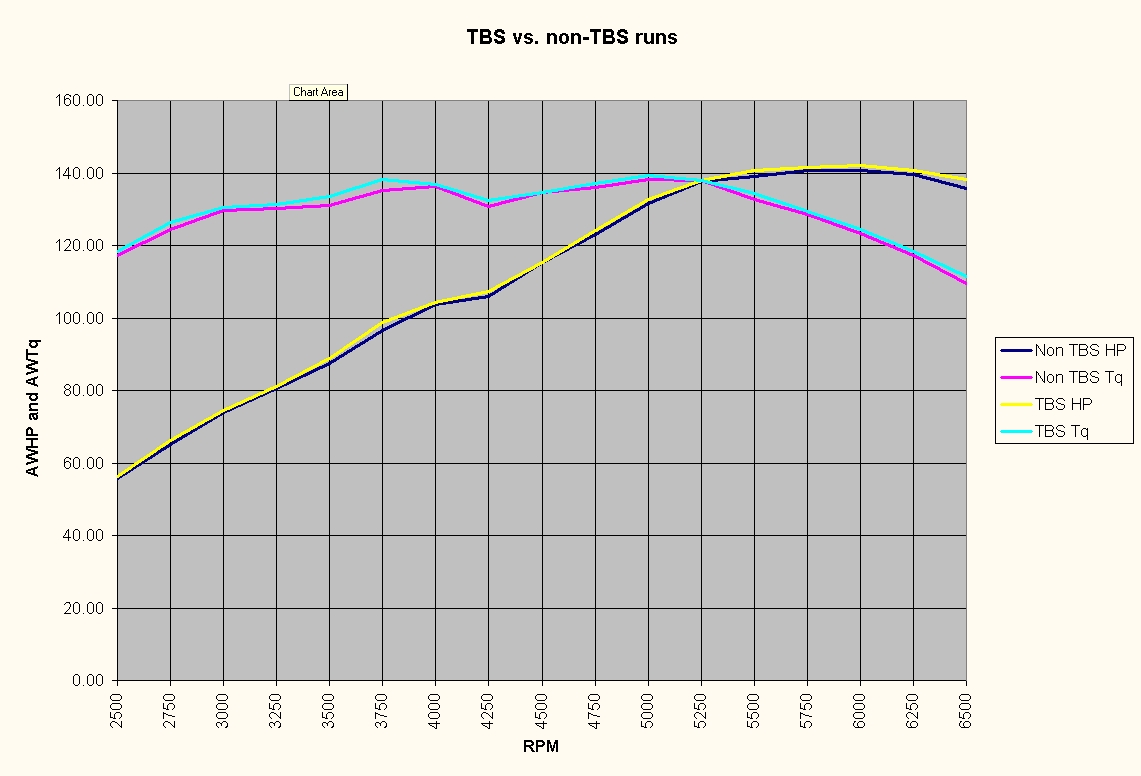
IMHO the Nissan Sentra results represent a "best case" scenerio for a TBS and the above Subaru results represent the norm. I'll keep looking for some "worst case" results. I remember seeing power loss from a TBS before but have to find the dyno results again.
http://www.rs25.com/forums/f5/62859-...s-works-3.html
IMHO the Nissan Sentra results represent a "best case" scenerio for a TBS and the above Subaru results represent the norm. I'll keep looking for some "worst case" results. I remember seeing power loss from a TBS before but have to find the dyno results again.


Senior Member
AlphaSquad
SL Member
Joined: Aug 2008
Posts: 883
From: Beaumont, CA
Im sure a tbs adds power but at the same time if you get one of those Gimmick ones with the cookie cutter shapes in it Im sure it could be chalked up to a loss in power just as easily.
I agree about the gimmick TBS' like Airaid. What possible benefit could come from swirling the air as it enters the intake manifold long before the fuel is injected into the air stream? I find it inconceivable that the swirling effect continues in the combustion chamber after all the turns it makes to get there. Whatever swirling effect occurs in the combustion chamber is the result of OEM engineering.
OEMs spend millions on R&D to get maximum efficiency from engines today. If a simple 1" TBS added any significant power and mpg, they'd come on our cars from the factory. IMO the R&D invested by companies like Airaid consists entirely of figuring out which TBS applications will sell sufficient units to make a profit and designing a TBS that fits those applications. I highly doubt that there was any flow bench or dyno testing done.
I have to admit that even the Subaru results show some very slight gains in hp and tq but it's slight enough to fall within typical dyno variation between runs. But if the possibility of gaining 1-3 ft/lbs and 1-2 hp at certain points in the rpm range are worth the cost of a TBS to you, enjoy it. Better yet, dyno test your car with and without the TBS and post the results. That would be the perfect way to shut-up all the nay-sayers. As the saying goes: "Put up or shut up"...
Last edited by ScionFred; Feb 2, 2011 at 08:39 PM.

Former Sponsor
Joined: Dec 2010
Posts: 99
From: Torrance & Canoga Park, CA
If anybody is interested, we sell TBS for the tC1 and xB2:
http://www.world-motorsports.com/wms...ex&cPath=25_16 , check link for price thank you.
http://www.world-motorsports.com/wms...ex&cPath=25_16 , check link for price thank you.
Last edited by Guillermo_DESCENDANT; Feb 3, 2011 at 04:21 PM.
So far it appears that a TBS can actually provide small performance gains on specific MPI applications that benefit from the small increase in intake plenum volume. The Sentra SE/R results (if legit) certainly present a good argument for the TBS on that particular engine. However I have learned that the Sentra results were posted by nmuk152 who was actively making and selling TBS' at the time. I'll let the reader decide if that affects his credibility. The independently performed Subaru results show no gains at all.
So what we need to know is does our 2AZ-FE engine benefit from a slight increase in intake plenum volume? The general concensus among the TC guys is that a 1" TBS actually reduces our engine performance. I found some actual dyno results performed by soros151 with and without a 1" TBS. To the best of my knowledge the TBS in question was of the Helix variety like the Airaid TBS. Unfortunately the thread is from 2006 and the images are no longer available. However the summary of the results are still there and if anyone is really interested they could try PM'ing soros151 with any questions.
Dyno test summary:
Baseline is:
158.53whp / 161.47wtq.
TBS Dyno Run:
153.15whp/ 159.08
Thread link: https://www.scionlife.com/forums/sho...light=tbs+dyno
Dyno result post link: https://www.scionlife.com/forums/sho...&postcount=119
I found more dyno results for a TC with and w/o a TBS:
These look a little better for the TBS but IMO it's worth noting that the cool engine runs were made with the TBS and the engine wasn't allowed to cool down for the results w/o the TBS. Either way, the results are within the range of typical dyno run variance.
I got baseline at 157hp(!!) and 167torque and with the spacer on with 156hp and 172torque.

Post link: https://www.scionlife.com/forums/sho...9&postcount=81
FWIW my own Dynapack results varied by +/- 4 ft/lbs and 3 hp between 3 runs. The first run yielded the highest results and the heat-soaked 3rd run producing the lowest results.
So what we need to know is does our 2AZ-FE engine benefit from a slight increase in intake plenum volume? The general concensus among the TC guys is that a 1" TBS actually reduces our engine performance. I found some actual dyno results performed by soros151 with and without a 1" TBS. To the best of my knowledge the TBS in question was of the Helix variety like the Airaid TBS. Unfortunately the thread is from 2006 and the images are no longer available. However the summary of the results are still there and if anyone is really interested they could try PM'ing soros151 with any questions.
Dyno test summary:
Baseline is:
158.53whp / 161.47wtq.
TBS Dyno Run:
153.15whp/ 159.08
Thread link: https://www.scionlife.com/forums/sho...light=tbs+dyno
Dyno result post link: https://www.scionlife.com/forums/sho...&postcount=119
I found more dyno results for a TC with and w/o a TBS:
These look a little better for the TBS but IMO it's worth noting that the cool engine runs were made with the TBS and the engine wasn't allowed to cool down for the results w/o the TBS. Either way, the results are within the range of typical dyno run variance.
I got baseline at 157hp(!!) and 167torque and with the spacer on with 156hp and 172torque.
Post link: https://www.scionlife.com/forums/sho...9&postcount=81
FWIW my own Dynapack results varied by +/- 4 ft/lbs and 3 hp between 3 runs. The first run yielded the highest results and the heat-soaked 3rd run producing the lowest results.
Last edited by ScionFred; Feb 2, 2011 at 10:16 PM.
Thanks for reporting your findings Fred ! I'd probably give the Descendent a try if I could get it for half the price shipped, but I somehow doubt that'll happen. It was once suggested to me I could make a smooth bore spacer out of a block of wood -- maybe I should give that a shot  ?
?
BTW -- If any manual shift xB2 owner is seriously considering dropping $95 plus ship without needing the bore port, I instead suggest installing an in-cabin short shifter for an easily lower net cost (free shipping and I buy the original shift assembly) which will definitely provide a more enjoyable driving experience, and with no HP or torque issues !
!
! I'd probably give the Descendent a try if I could get it for half the price shipped, but I somehow doubt that'll happen. It was once suggested to me I could make a smooth bore spacer out of a block of wood -- maybe I should give that a shot ?BTW -- If any manual shift xB2 owner is seriously considering dropping $95 plus ship without needing the bore port, I instead suggest installing an in-cabin short shifter for an easily lower net cost (free shipping and I buy the original shift assembly) which will definitely provide a more enjoyable driving experience, and with no HP or torque issues
!