


HID Help Thread


Well I was just hoping you weren't confusing the color (measured in k) with luminous intensity (measured in lumens).
You said a 55w 5000k would look like 4300k, which isn't the case.
5000k is the sweet spot of bulb colors with regards to light output in lumens. It is the brightest bulb color you can get. So there is no way that adding more power to the brightest bulb color (5000k) would knock it down to a color that is less bright (4300k as you said).
I'd say that the simplest way to put it would be: 55w brings every bulb color closer to the sweet spot (5000k).
You said a 55w 5000k would look like 4300k, which isn't the case.
5000k is the sweet spot of bulb colors with regards to light output in lumens. It is the brightest bulb color you can get. So there is no way that adding more power to the brightest bulb color (5000k) would knock it down to a color that is less bright (4300k as you said).
I'd say that the simplest way to put it would be: 55w brings every bulb color closer to the sweet spot (5000k).

Senior Member


SL Member
Joined: Jun 2011
Posts: 312
From: Seattle, WA
4300k is the brightest bulb you can get actually, at least to humans with human eyeballs. 5000k is probably only about 3% dimmer, and starting at about 6000k you start losing brightness a lot faster than 3% per 1000k. Yay, blue wavelengths, useless to our eyeballs and bane of the atmosphere (why do you think the atmosphere scatters them and turns blue?).
Anyway my experience is that 50 vs. 35 watt ballasts don't make a significant difference in color temp to 4300k, 4500k, and 5000k bulbs, and I've tried all three bulbs in recent weeks with both 35 & 50-watt ballasts (credit to my friend Kevin IRL and on this forum for his part in this). Maybe 0.1 or 0.2k in color temp reduction, surprised both of us I think at how subtle the change really was.
Anyway my experience is that 50 vs. 35 watt ballasts don't make a significant difference in color temp to 4300k, 4500k, and 5000k bulbs, and I've tried all three bulbs in recent weeks with both 35 & 50-watt ballasts (credit to my friend Kevin IRL and on this forum for his part in this). Maybe 0.1 or 0.2k in color temp reduction, surprised both of us I think at how subtle the change really was.
Wow, my fault I was completely wrong lol. I don't know where I got that 5000k was the sweet spot. Thanks for clearing that up. And I believe you when you say the wattage doesn't make that huge of a difference. I guess its just a mental thing for me lol.

Member
SL Member
Joined: Feb 2011
Posts: 77
Just an FYI,
Here's my experience and opinion on 50/55-watt HIDs vs. 35-watt. 50/55-watt kits are brighter but won't help you see better, seems counter-intuitive but read on: the foreground brightness combined with the high contrast with the surrounding darkness outside of the projector's beam area constricts your pupils and reduces your ability to see outside of the lighted area, and the lighted area itself isn't increased vs. 35-watt.
I'm not going to rule out that higher wattage ballasts might be useful in rare circumstances, but I think most of you would actually be better off with 35 watt HIDs: you might see better overall.
Here's my experience and opinion on 50/55-watt HIDs vs. 35-watt. 50/55-watt kits are brighter but won't help you see better, seems counter-intuitive but read on: the foreground brightness combined with the high contrast with the surrounding darkness outside of the projector's beam area constricts your pupils and reduces your ability to see outside of the lighted area, and the lighted area itself isn't increased vs. 35-watt.
I'm not going to rule out that higher wattage ballasts might be useful in rare circumstances, but I think most of you would actually be better off with 35 watt HIDs: you might see better overall.
However, an advantage to higher wattage ballasts is seeing better in the rain since the water kinda sucks in the light, or when driving on newly paved black roads... or both.
However, most cars that pass me while forgetting to turn off their highs don't bother me too much. I can still see the road ahead just fine, and doesn't strain my eyes if I just keep them straight ahead. Unless they have super bright highs, which is only maybe 10% of them. (the tC included) So I'll be sticking with my 50w ballasts from www.TheRetrofitSource.com
4300k is the brightest bulb you can get actually, at least to humans with human eyeballs. 5000k is probably only about 3% dimmer, and starting at about 6000k you start losing brightness a lot faster than 3% per 1000k. Yay, blue wavelengths, useless to our eyeballs and bane of the atmosphere (why do you think the atmosphere scatters them and turns blue?).
Anyway my experience is that 50 vs. 35 watt ballasts don't make a significant difference in color temp to 4300k, 4500k, and 5000k bulbs, and I've tried all three bulbs in recent weeks with both 35 & 50-watt ballasts (credit to my friend Kevin IRL and on this forum for his part in this). Maybe 0.1 or 0.2k in color temp reduction, surprised both of us I think at how subtle the change really was.
Anyway my experience is that 50 vs. 35 watt ballasts don't make a significant difference in color temp to 4300k, 4500k, and 5000k bulbs, and I've tried all three bulbs in recent weeks with both 35 & 50-watt ballasts (credit to my friend Kevin IRL and on this forum for his part in this). Maybe 0.1 or 0.2k in color temp reduction, surprised both of us I think at how subtle the change really was.
I hooked up a 4300k bulb next to a 5000k bulb, and the 4300k bulb almost totally washed out the 5000k bulb when aimed on the pavement.
4300k is OEM color for a reason. They've done a lot more research than we have, folks! The difference between the 4300k and 5000k is amazing in usable light!
For most of you, 4300k @ 35w will be an amazing upgrade if you are not going for that young curb appeal look of blue, but want whiter light than standard yellow halogen bulbs. Remember also, HIDs tend to gain kelven rating as they age, so it will slowly start to lose yellow as it ages for 4300k, or gain bluer tint in the case of 5000k
If you are like me, and brighter light doesn't bother you, then go for a higher wattage. You will see better once the rainy season comes! Gotta watch out for that black ice also in the winter! Good headlights save lives!
Senior Member
SL Member
Joined: Jun 2011
Posts: 312
From: Seattle, WA
I think you misunderstand me. I'm saying super-bright headlights make a human eyeball see less well in areas that are not lit by the headlights, i.e., night vision. That's human physiology, not a matter of opinion. It's important to be able to see (as much as possible) outside of the beam's pattern area, outside and above the cutoff. It really is amazing how much we humans can see in the dark, if we have to.
This is all knowledge that's taken for granted by light researchers, ophthalmologists, people like Daniel Stern (http://www.danielsternlighting.com/about/about.html), etc.
From Daniel Stern's web site:
I'm going without headlights from now on. ;)
This is all knowledge that's taken for granted by light researchers, ophthalmologists, people like Daniel Stern (http://www.danielsternlighting.com/about/about.html), etc.
From Daniel Stern's web site:
If you illuminate the foreground very strongly, your eyes will adapt to that big area of strong illumination, your pupils will become smaller, and your distance vision will be reduced. (On the other hand, if you take the route prescribed for so long by US headlamp regulations and have very LITTLE foreground illumination, you'll have a "black hole" in front of the car, and you'll be straining to see what you're about to run over...)
So how does this relate to HID headlamps? Well, suddenly we have all this extra light to work with, because we're using an HID arc capsule instead of a bulb. Where are we going to put the extra light? We can put some of it into the high-intensity zone of the beam (the "hot spot") to improve distance vision, but we can't put too much of it there, 'cause we'll glare other drivers (and exceed regulated maximum intensities). We can spread some of it around in the rest of the beam, but there are often even stricter maxima outside of the hot spot or zone, and too much "generalized" light causes veiling glare and backdazzle in bad weather. So we put a lot of it in the foreground. To an extent, that's a good thing, because US headlamps have typically had too little foreground light (see above). But over a certain level, which is quite easy to exceed with an HID headlamp, undesireable things start to happen. We sacrifice distance vision, we get high levels of reflected-light glare on wet roads, that sort of thing.
So how does this relate to HID headlamps? Well, suddenly we have all this extra light to work with, because we're using an HID arc capsule instead of a bulb. Where are we going to put the extra light? We can put some of it into the high-intensity zone of the beam (the "hot spot") to improve distance vision, but we can't put too much of it there, 'cause we'll glare other drivers (and exceed regulated maximum intensities). We can spread some of it around in the rest of the beam, but there are often even stricter maxima outside of the hot spot or zone, and too much "generalized" light causes veiling glare and backdazzle in bad weather. So we put a lot of it in the foreground. To an extent, that's a good thing, because US headlamps have typically had too little foreground light (see above). But over a certain level, which is quite easy to exceed with an HID headlamp, undesireable things start to happen. We sacrifice distance vision, we get high levels of reflected-light glare on wet roads, that sort of thing.
Member
SL Member
Joined: Feb 2011
Posts: 77
I think you misunderstand me. I'm saying super-bright headlights make a human eyeball see less well in areas that are not lit by the headlights, i.e., night vision. That's human physiology, not a matter of opinion. It's important to be able to see (as much as possible) outside of the beam's pattern area, outside and above the cutoff.
Give it a month or two.
But again, no two people are alike. Try something for a month, then try something else. I've been there, done that and found what works best for me.
To reach their own.
But you know what? If i had 55w ballasts, and you rode with me in my car, you will probably complain about not seeing above the cutoff.
If you rode the next day, and I lied, and said I had 35w ballasts when I still had the 55w ones, you might then say "oh yeah, looks a lot better"
If you saw a website saying they've done research on HIDs and that they have a flicker that causes headaches, you will probably start having headaches after driving your car with HIDs. (research:The Placebo Effect)
Now, I'm not saying the people who wrote that article don't know what they're talking about. I'm sure they are correct, but that doesn't mean 100% of people are going to be negatively effected when going from 35w to 55w. One reason being the change is very subtle. I have also seen first hand that my eyes can adjust to an instant cutoff in light after a month or so.
It's just the way we silly humans are


Senior Member
SL Member
Joined: May 2008
Posts: 201
From: WI
to actually improve lighting in the snow / rain / fog, you would lower your K temp to 3000K to achieve a yellow color. The wavelength at this K temp would "cut" through the wetness and snow a lot better than say, the 4300K-6000K.
So running a higher wattage ballast wouldn't increase visibility in such weather conditions, it might actually hinder your ability to see (not to mention the wavelengths would refract more easily perhaps)
There's a reason why "fog lights" were invented and named as so. lol. The foglights also take care of foreground lighting in the case of the TC projector bowls have foreground limiters (TC1 projectors have them).
So running a higher wattage ballast wouldn't increase visibility in such weather conditions, it might actually hinder your ability to see (not to mention the wavelengths would refract more easily perhaps)
There's a reason why "fog lights" were invented and named as so. lol. The foglights also take care of foreground lighting in the case of the TC projector bowls have foreground limiters (TC1 projectors have them).
Member
SL Member
Joined: Feb 2011
Posts: 77
to actually improve lighting in the snow / rain / fog, you would lower your K temp to 3000K to achieve a yellow color. The wavelength at this K temp would "cut" through the wetness and snow a lot better than say, the 4300K-6000K.
So running a higher wattage ballast wouldn't increase visibility in such weather conditions, it might actually hinder your ability to see (not to mention the wavelengths would refract more easily perhaps)
There's a reason why "fog lights" were invented and named as so. lol. The foglights also take care of foreground lighting in the case of the TC projector bowls have foreground limiters (TC1 projectors have them).
So running a higher wattage ballast wouldn't increase visibility in such weather conditions, it might actually hinder your ability to see (not to mention the wavelengths would refract more easily perhaps)
There's a reason why "fog lights" were invented and named as so. lol. The foglights also take care of foreground lighting in the case of the TC projector bowls have foreground limiters (TC1 projectors have them).
Yes, I understand why foglights are invented. No, I didn't say brighter bulbs are better in fog.
I have experienced all of this first hand. You have not. I doubt you have 3000k fogs.
I turn my fogs off in foggy weather as it reflects up into my view because they are not projectors.
Senior Member
SL Member
Joined: May 2008
Posts: 201
From: WI
YSo are you going to drive around with 3000k headlights?
Yes, I understand why foglights are invented. No, I didn't say brighter bulbs are better in fog.
I have experienced all of this first hand. You have not. I doubt you have 3000k fogs.
I turn my fogs off in foggy weather as it reflects up into my view because they are not projectors.
Yes, I understand why foglights are invented. No, I didn't say brighter bulbs are better in fog.
I have experienced all of this first hand. You have not. I doubt you have 3000k fogs.
I turn my fogs off in foggy weather as it reflects up into my view because they are not projectors.
It's either that route, or get mini projectors modded into the actual APT / VRD fogs I have and just keep the plastic lens down there to project it from debri. Either way, I will run 3000K fogs prior to winter settling in Wisconsin.
So all-in-all ; I'll run my quad retro with even more projectors in the fog area to shine more yellow for foreground like how fogs should function. 
Member
SL Member
Joined: Feb 2011
Posts: 77
I don't run 3000K bulbs yet...but I have modded my 08 OEM projectors to be in-headlight fogs / extra intensity to my retros (which are e46 modded lens projectors 5000K replacing my high beams), so yes they are set to run 3000K, but right now they run 4300K. Just don't feel like buying 3000K HID bulbs yet..or short on money cuz i want a whole new kit.
It's either that route, or get mini projectors modded into the actual APT / VRD fogs I have and just keep the plastic lens down there to project it from debri. Either way, I will run 3000K fogs prior to winter settling in Wisconsin. So all-in-all ; I'll run my quad retro with even more projectors in the fog area to shine more yellow for foreground like how fogs should function.
It's either that route, or get mini projectors modded into the actual APT / VRD fogs I have and just keep the plastic lens down there to project it from debri. Either way, I will run 3000K fogs prior to winter settling in Wisconsin.
So all-in-all ; I'll run my quad retro with even more projectors in the fog area to shine more yellow for foreground like how fogs should function. I personally don't like 3000k lights, and it makes me wonder what the reason is for not being stock on any cars.
I'm not a huge fan of 5000k either, but 4300k is definitely where it's at.
I've been contemplating on whether or not to retrofit some projectors into my fog light housings on my '11 tC. This will definitely help reduce the glare that reflects upward in foggy situations. Where I am from, fog is quite a common occurrence , and is sometimes very thick on my way home from work at night. If I do put in some projector fogs, I'm going have to throw another set of 4300k lights in there, because I like my color temps to match.
Senior Member
SL Member
Joined: May 2008
Posts: 201
From: WI
Here is the quad setup...

And when I was test fitting the OEM projector into the fog area... didn't fit without cutting the mounting area in the bumper for the fogs lol (I had already shaved off quite a bit on the oem projector as well..) So i put them back into the 08-10 headlights I had.
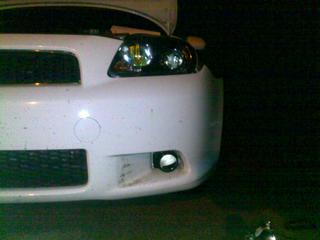
And when I was test fitting the OEM projector into the fog area... didn't fit without cutting the mounting area in the bumper for the fogs
lol (I had already shaved off quite a bit on the oem projector as well..) So i put them back into the 08-10 headlights I had.

Junior Member
Joined: Sep 2011
Posts: 15
HELP! ASAP!
So I installed my DDM Slim 6k 55W the other day and at first it seems stable. I drove it yesterday and noticed that when I turned on my low beam, my lights flicked and came on but the passenger side came off after a split sec. I tried to troubleshoot it. Disconnect and reconnect the cable and it worked again. thought it was a glitch. then drove a few miles.. then went off again. did it again, D/C then reconnect then it worked and guess what? same thing happened. The Drivers side looks pretty stable but the passenger isn't. and add to that, the passenger side seems a lil bit softer white or giving out less light compared to the drivers side. I called DDM right away and they told me that I need a relay harness and up the fuse. Do you guys have any inputs on this?? I read on this thread that nobody had a problem with this so far. I have a 2012 tC btw. thanks!!
^
Sounds like they just don't want to admit a faulty product. I say swap sides for your ballasts. If the problem is corrected on the passenger side and the driver side now starts acting up, I'd say you have a strong case to present to DDM.
Sounds like they just don't want to admit a faulty product. I say swap sides for your ballasts. If the problem is corrected on the passenger side and the driver side now starts acting up, I'd say you have a strong case to present to DDM.
Junior Member
Joined: Sep 2011
Posts: 15


Senior Member
SL Member
Joined: Jan 2006
Posts: 322
From: Ambridge, PA
Has anyone on here noticed radio interference with there hid's. If my radio signal is on the week side and I turn my hid's on it just turns to static. I have 5000k h11 35w digital ac ballasts from vvme.


